Most advice about blood pressure logs starts with the log itself — what columns to include, how often to fill it in — and skips the part that actually determines whether the numbers going into it mean anything: how the reading was taken. A blood pressure reading can shift by a meaningful amount depending on posture, timing, and whether you talked through it, which means two people with genuinely identical blood pressure can log very different numbers just from measuring differently. Worth sorting out before worrying about the log itself.
How to actually get an accurate reading
The CDC's own guidance is specific about this, and most of it comes down to being still and supported: "Sit in a comfortable chair with your back supported for at least 5 minutes before your reading," with "both feet flat on the ground" and legs uncrossed, arm "resting on a table at chest height." Two easy-to-miss details from the same guidance: empty your bladder first, and don't eat or drink anything in the 30 minutes before — both can push the reading higher than your actual baseline.
Cuff placement matters too: it should be "snug but not too tight" and against bare skin, not pressed over a sleeve. And the CDC is direct about one thing people don't expect — "do not talk while your blood pressure is being measured," since talking itself raises the reading.
Take two readings, not one
The CDC recommends taking "at least two readings, 1 or 2 minutes apart" each time you measure, rather than treating a single number as the result. This matters because any one reading can be thrown off by something momentary — you shifted, the cuff sat slightly wrong, you were mid-thought about something stressful — and a lone high or low reading is easy to misread as a trend when it's actually noise. Logging both readings, not just the better-looking one, is what makes a weekly average worth trusting.
| Rule | What it prevents |
|---|---|
| Sit supported for 5 minutes first | An artificially high reading from having just walked in or sat down |
| Feet flat, legs uncrossed | Crossed legs can raise systolic pressure by several points |
| No talking during the reading | Talking measurably raises the number being recorded |
| Two readings, 1-2 minutes apart | Mistaking a one-off fluctuation for a real trend |
What a log needs beyond the two numbers
Systolic and diastolic are the headline numbers, but a log that only has those two columns misses most of what makes tracking useful over time. Pulse alongside each reading matters because a rise in resting pulse alongside blood pressure changes can point to something worth mentioning at your next appointment rather than a two-number picture. A weekly average is more useful than any single day's numbers, precisely because normal day-to-day variation makes any one reading a weak signal on its own. And a medication log with dose and time taken sitting next to the readings makes it far easier to notice whether a change in medication actually shifted the numbers, rather than trying to reconstruct the timeline from memory at an appointment weeks later.
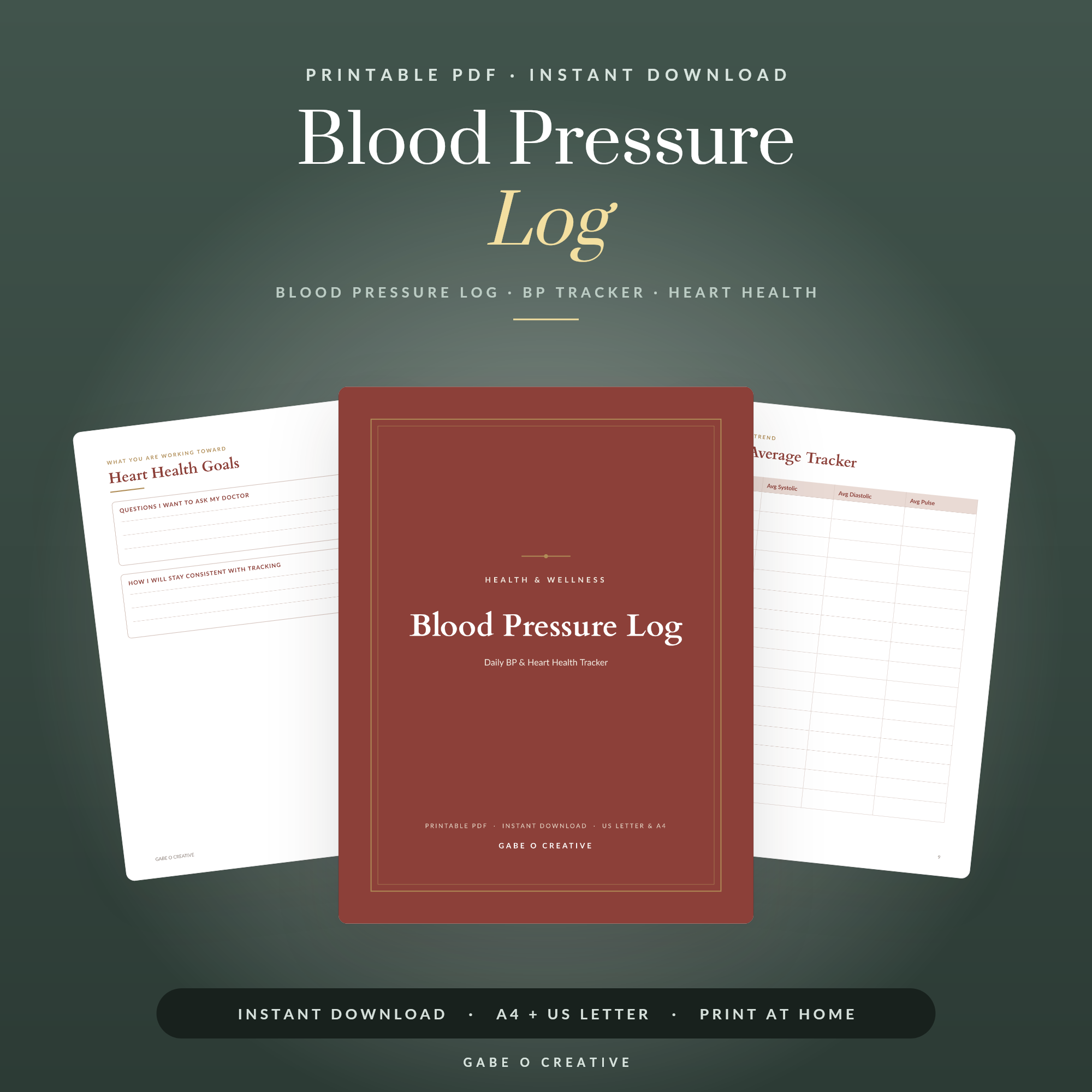
The Blood Pressure Log is built around that fuller picture: daily readings with systolic, diastolic and pulse, a weekly average tracker, a medication log, a weight tracker, and a doctor-notes page so the readings arrive at an appointment already organised into something a clinician can actually use, rather than a loose stack of numbers.
If medication timing across multiple prescriptions is the harder part to stay on top of, a dedicated medication tracker covers that in more depth. And since weight and diet both factor into heart-health tracking alongside blood pressure, a macro and calorie tracker pairs naturally with a BP log for anyone managing more than one health metric at once — or the Health & Fitness Planner Bundle covers several of these trackers together for a more complete system.