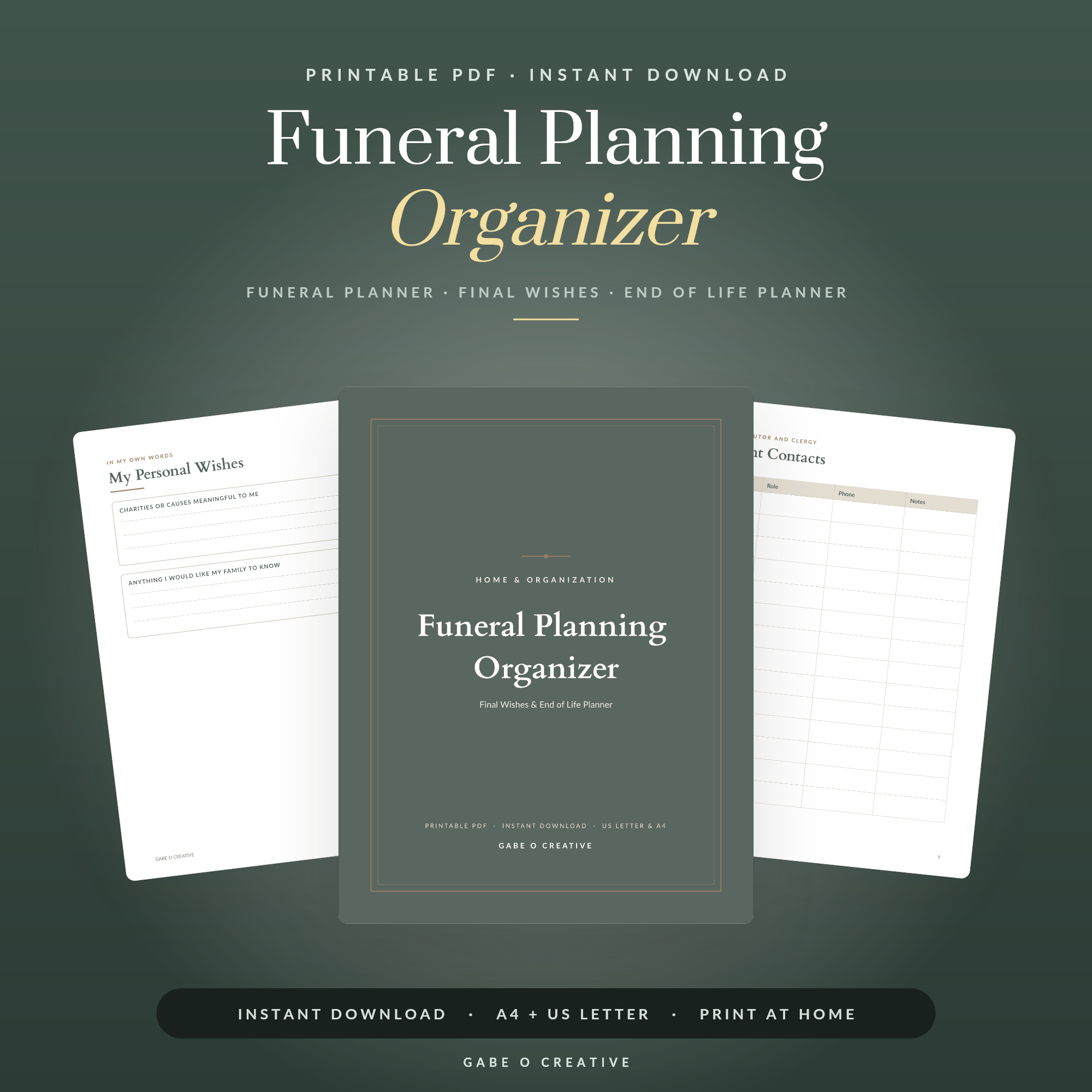
A funeral planning organizer is one of those documents nobody wants to fill in and everybody is grateful for. The hour you spend on it is not really for you — it is for the people who will otherwise sit in a funeral director's office three days after losing you, trying to guess whether you wanted burial or cremation, and quietly worrying about the cost. Writing it down removes both the guessing and the guilt. Our funeral planning organiser gives you the prompts so you are not staring at a blank page.
Been meaning to do this? Print the planning organiser and fill in the first page — burial or cremation, and two people to call. Ten minutes covers the most important part.
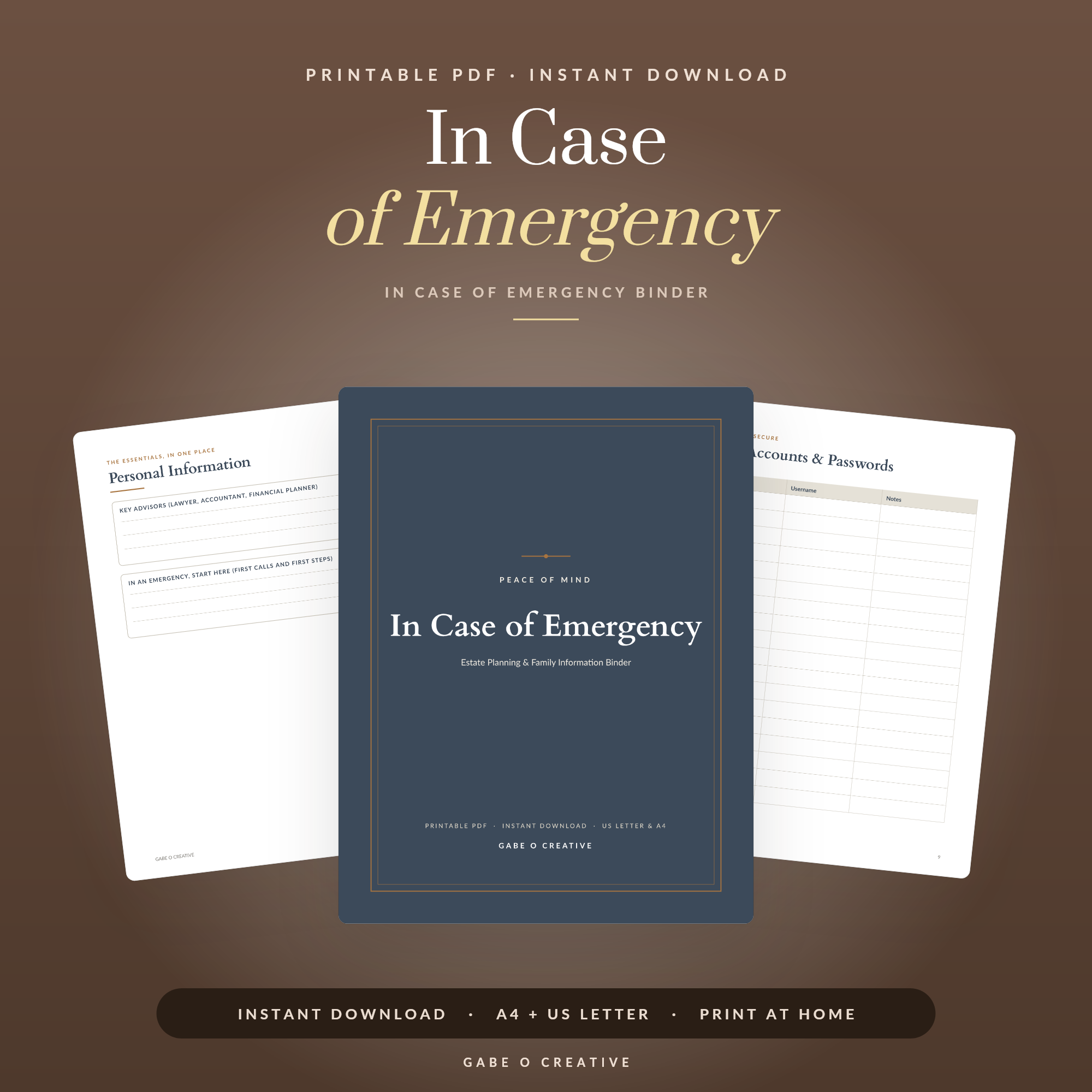 Shop In Case of Emergency →
Why This Matters More Than People Think
Bereaved families do not usually struggle with grief and admin separately — the admin arrives first, at the worst possible moment, and has deadlines attached. Within a few days someone has to register the death, choose a funeral director, make roughly forty decisions and find documents they may never have seen.
Every one of those decisions is easier if you left a note. And there is a specific kindness in it that people underestimate: it removes the arguments. Families disagree about what someone would have wanted, and those disagreements land at the least forgiving moment imaginable. A written wish ends the discussion.
Your will is not the answer
This surprises people: funeral wishes are not legally binding in the UK, even written into a will. Worse, wills are frequently not read until after the funeral has taken place. A separate, findable document is what actually gets used.
What to Actually Record
Start with the four things that get asked first. Everything after that is a bonus.
| Priority | What |
|---|---|
| 1 | Burial or cremation |
| 2 | Whether a funeral plan is already paid for, and with whom |
| 3 | Three or four people to notify first |
| 4 | Where the will, insurance and key documents are kept |
| 5 | Service preferences — religious or not, music, readings |
| 6 | Anything you specifically do not want |
That last row earns its place. "No black, no hymns, and absolutely not that poem" is genuinely useful information, and people are often clearer about what they would hate than what they would like.
The practical details nobody thinks of
- Who should not be contacted, if that applies. Families are complicated, and this is easier written down than explained.
- Pets — who takes them. This is the detail that most often gets missed entirely.
- Online accounts — where the password manager is and who holds the master key. Our password keeper guide covers doing that safely.
- Whether you want donations instead of flowers, and to which charity.
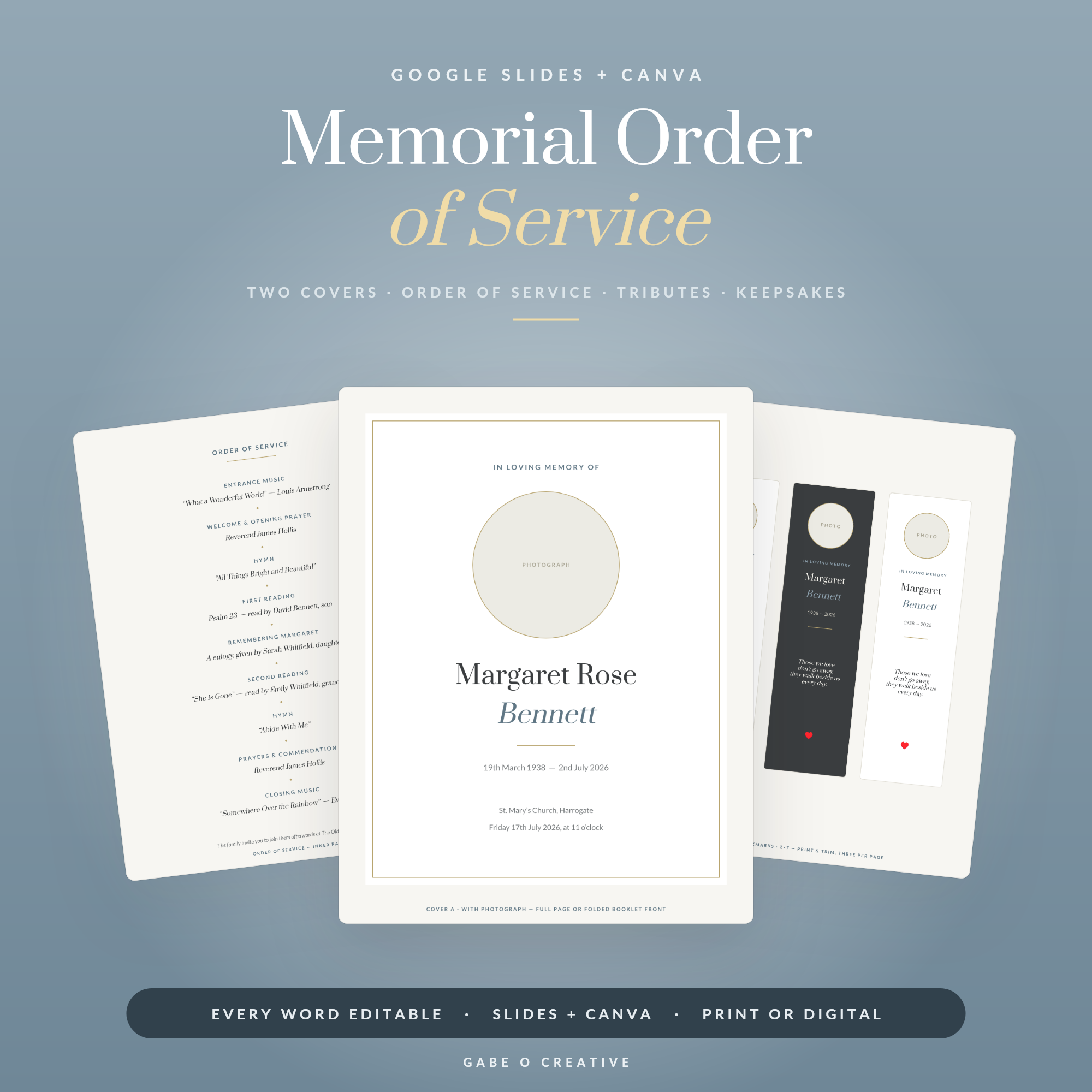 Shop Memorial Order of Service — Editable Funeral Program Template for Google Slides & Canva: Two Covers, Service Order, Hymns, Photo Tribute, Thank You Cards & Bookmarks →
What It Costs, Honestly
A full-service funeral in the UK commonly runs somewhere around £4,000 to £5,000, and direct cremation considerably less. Those figures vary a great deal by region and provider, so treat them as a starting point rather than a quote — and know that prices are now more comparable than they used to be, since providers must publish standardised price lists.
Two things worth writing down alongside your wishes:
- Whether a plan is already paid for. Families routinely pay twice because nobody knew a plan existed.
- Whether you would rather they spent less. Many people would, and saying so explicitly frees a family from feeling that spending more is what love looks like.
That second point matters more than the first. Grieving people overspend, and a line saying "please keep it simple, I would rather the money went to the grandchildren" is a genuine gift.
Where to Keep It
The commonest failure is not writing nothing — it is writing something nobody can find. A sealed envelope in a safe that only you can open is no better than not having one.
- Keep it with your other important papers, not hidden separately.
- Tell at least two people where it is, and make sure they are not both likely to be travelling at the same time.
- Give a copy to whoever would most likely handle things.
- Note where it is in your will, so the solicitor points at it.
- Review it every few years, or whenever something significant changes.
If you are pulling the wider paperwork together at the same time, the estate and emergency binder covers the documents, accounts and contacts in one place, and our emergency binder guide covers what belongs in it — including the things that should never go in one. The home inventory handles possessions, which matters for probate as well as insurance.
If you are the one arranging a funeral now
You have our sympathy, and one practical suggestion: you do not have to decide everything today. Registering the death and appointing a funeral director are the only urgent steps; the service details can wait a few days while you catch your breath. If you need an order of service, the memorial order of service template is editable, so you can put it together yourself without a designer at a point when nobody wants another appointment.
 Shop Home Inventory →
How to Raise It With Family
The document is the easy part. Telling someone it exists is what people put off, usually because they expect the conversation to be upsetting. In practice it rarely is — most families are relieved.
Attach it to something practical rather than announcing it. "I updated my will and wrote down what I want for the funeral — it is in the blue folder with the insurance papers" lands very differently from sitting someone down for a talk. You are passing on the location of a document, not opening a discussion about mortality.
Expect the deflection. "Don't talk like that, you have years yet." The useful reply is that this is exactly why you are doing it now, calmly, rather than leaving it to a week when nobody can think straight. Then move on. You do not need them to engage with it emotionally — you need them to know where it is.
If you are the adult child raising it with a parent, going first works remarkably well. Write your own, mention you have done it, and ask whether they have. It turns an awkward request into a shared piece of admin, and a surprising number of parents have already written something and never mentioned it.
A note on timing
The natural moments are when you make or update a will, when you move house, after a bereavement in your circle, or when a new grandchild arrives and you are thinking about the future anyway. None of these require a health scare, and doing it in an ordinary week is precisely what makes it unremarkable.
Funeral Planning FAQs
What is a funeral planning organiser?
A document recording your wishes and the practical details your family would otherwise have to guess at — burial or cremation, music and readings, who to contact, and where your important paperwork is kept.
What should you write down?
Burial or cremation, any service preferences, three or four people to notify first, where the will and insurance documents are, and any funeral plan already paid for. Everything else is a bonus.
How much does a funeral cost in the UK?
Commonly around £4,000 to £5,000 for a full-service funeral, with direct cremation considerably less. Costs vary widely by region and provider, so treat any figure as a starting point rather than a quote.
Where should the document be kept?
Somewhere findable, and tell at least two people where. A sealed envelope in a safe nobody can open, or a document only you can access, is the commonest and most avoidable failure.
Is a funeral wishes document legally binding?
No. Funeral wishes are not legally enforceable in the UK, even in a will — and wills are often read after the funeral. That is precisely why a separate, findable document matters.
When should you write one?
Whenever it occurs to you, and certainly alongside making a will. It takes about an hour, and the people who most wish they had one are the ones who never got round to it.
This is general guidance rather than legal or financial advice — for wills, probate or a pre-paid plan, take proper advice.
Give your family an easier week. Print the funeral planning organiser and start with page one, or browse the full Home & Organization collection.