Most men who start a prayer journal stop within a month, and it is almost never for the reason they assume. It is not discipline, and it is not sincerity. It is that a blank page implicitly asks for an essay — and an essay needs time, a clear head and something worth saying, three things that are not reliably available at half six in the morning. Change the format and the habit survives. The Digital Prayer Journal is laid out around a short daily structure for exactly that reason.
Starting again this month? The Digital Prayer Journal gives you a dated page with prompts already in place — editable in Google Slides or Canva, printable, or usable on a tablet.
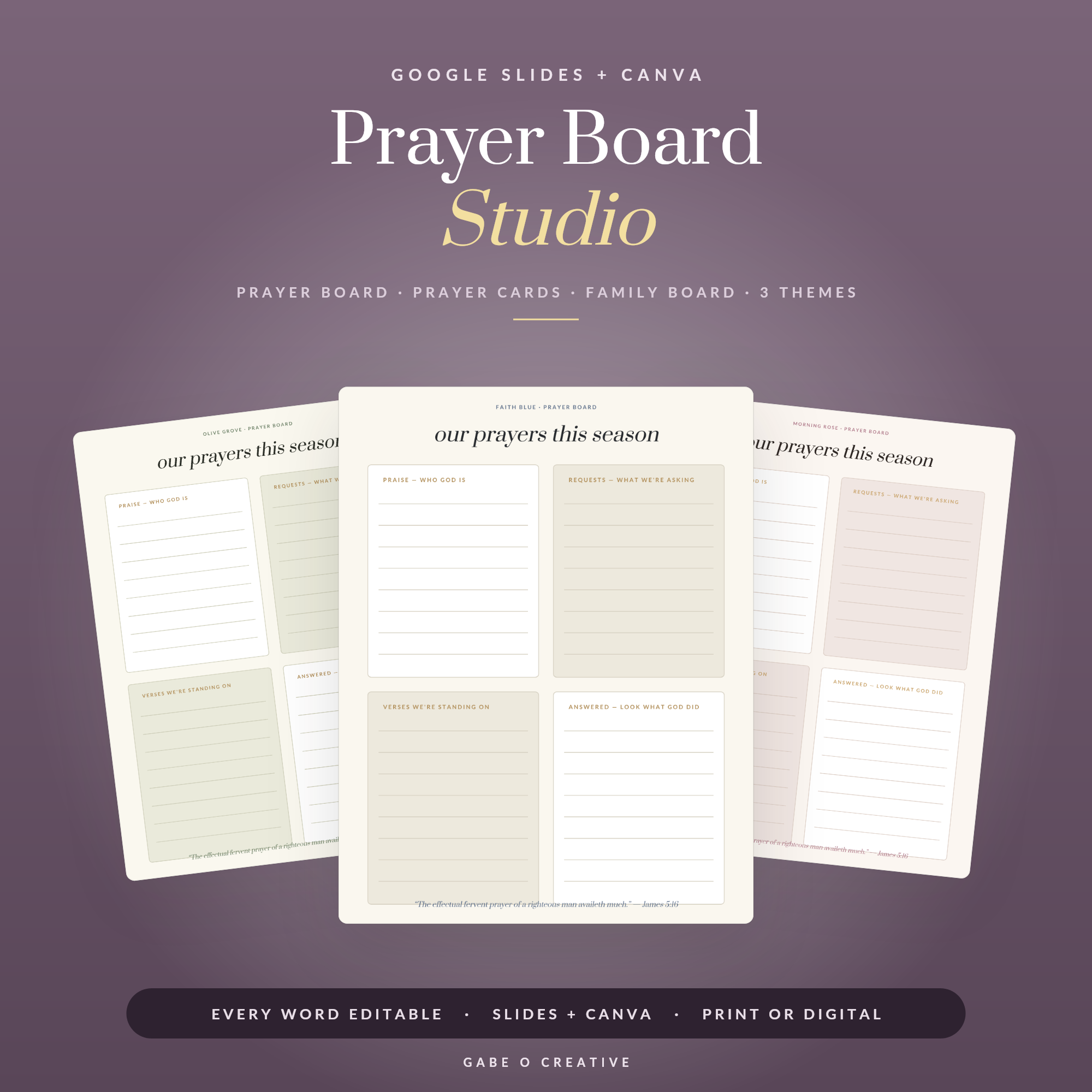 Shop Prayer Board Studio — Editable War Room Prayer Wall Kit, Google Slides + Canva Template: Boards, Prayer Cards & Family Edition, 3 Themes →
Four Lines Is Enough
A daily entry needs four things and nothing else:
- The date. Not decoration — it is what makes the journal readable later, and later is where the value is.
- What you are asking for. Short, specific, named. "Work" is not an entry; "the conversation with Dave on Thursday" is.
- One line from what you read. A verse, a phrase, a single thought. One line, not a summary.
- Anything answered. Left mostly blank most days, and the most valuable column in the book.
That is a five-minute entry, and five minutes is the correct target. Not because prayer should be brief, but because the journal has to survive a bad week to be any use — and a format that only works when you have twenty unhurried minutes will not.
Specific beats spiritual
The instinct with a journal is to write the version that sounds right. Resist it. "Patience with the kids at bedtime" is a more useful entry than "growth in godliness", because in six weeks you will know whether anything changed. Vague entries cannot be answered, and an entry that cannot be answered cannot be logged as answered.
Why Attempts Stop in Week Three
The pattern is consistent enough to plan around. The first week runs on novelty. The second runs on momentum. Somewhere in the third a day is missed, then two, and the missed days become the reason to stop rather than a normal feature of any habit.
Two things prevent it. First, keep the floor low enough that a bad day still produces an entry — one line still counts, and a one-line day is what keeps the chain alive. Second, decide in advance that gaps are not failure. A journal with a fortnight missing in it is a journal that survived a fortnight, which is more than an abandoned one managed.
| What kills it | What to do instead |
|---|---|
| A blank page every morning | Fixed prompts, so nothing has to be decided |
| Writing in full paragraphs | Lists and fragments — it is a record, not a letter |
| No fixed time | Attach it to something you already do daily |
| Starting a new book after a gap | Carry on in the same one; leave the gap visible |
| Only writing when you feel like it | Write especially when you do not — those entries age best |
Attach It to Something You Already Do
New habits are unreliable on their own and reliable when bolted to an existing one. The first coffee, the ten minutes before anyone else is up, the parked car before walking into work — anything that already happens at the same time every day without you deciding.
Keep the journal physically there. Whatever the location is, the journal lives in it: on the kitchen table, in the bag, in the drawer by the kettle. Most missed days are logistics rather than intent — the book was upstairs.
Morning or evening
Both work and they do different jobs. Morning entries are mostly requests and tend to shape the day. Evening entries are mostly noticing, and are usually the more honest of the two. If you cannot decide, start with whichever slot is already quiet; the one you keep is the right one.
 Shop Scripture Wall Art Studio — 12 Editable Bible Verse Prints, Google Slides + Canva Template: Psalm 23, Philippians 4:13, Printable Christian Decor →
The Answered Column
This is the part that turns a diary into something worth owning, and it is the part most people leave out.
Answers rarely arrive as events. They arrive as a situation that quietly stopped being a problem, and the mind absorbs that within days — the worry is gone and so is the memory of it. Without a written record there is nothing to compare against, and a year of that is a year of genuinely not knowing what changed.
Go back once a month, read the previous month's requests, and mark anything resolved with the date. It takes ten minutes. It is also, for most people, the point at which the journal stops feeling like an obligation, because a page of dated answers is evidence in a way that memory is not.
Some things will not be answered
Leave them. Do not tidy the list, and do not quietly drop the entries that went nowhere. A journal that only records the wins is a journal you will not trust in a hard year, and the hard year is when you will most want to read it.
Keeping It Visible Without Making It a Performance
There is a middle ground between a book nobody sees and a wall of verses in the hallway. Most men land closer to the first, and a small amount of visibility helps — one card on a desk, a verse where you make coffee, a short list where you actually sit.
If a prayer wall or board is useful to you, the Prayer Board Studio covers the layout side of that, and the Scripture Wall Art Studio has editable verse prints if you would rather put one line somewhere you will see it daily than keep everything in a book. For the wider habit of writing while you read rather than after, our guide to starting a Bible study journal covers that side, and the prayer journal printable guide covers the formats themselves.
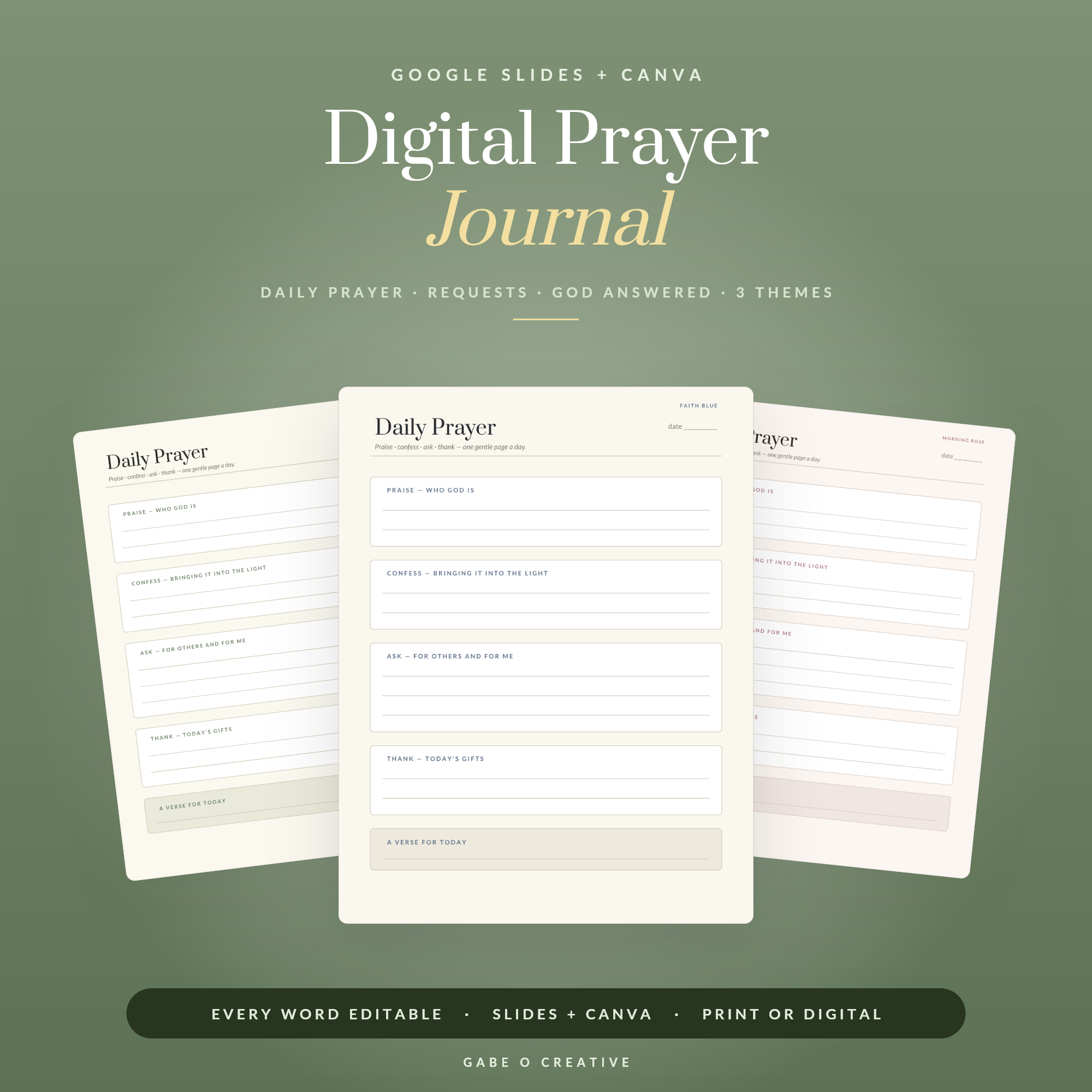 Shop Digital Prayer Journal — Editable Google Slides + Canva Prayer Template: Daily Pages, Request Boards & Answered Prayer Log, 3 Themes →
Prayer Journal FAQs
What should a man write in a prayer journal?
Four things is enough: the date, what you are asking for, one line from what you read, and anything that has been answered. Everything beyond that is optional. The test of an entry is not how it reads today but whether it means anything when you find it again in a year.
How long should it take?
Five minutes. A journal that needs twenty will not survive a normal week, and a habit that only works on good days is not a habit. If you regularly want longer, take longer — but build it so the floor is five minutes on a bad Tuesday.
Why do most prayer journals stop after a few weeks?
Usually because the format asks for writing rather than recording. An empty page invites an essay, an essay needs time and a clear head, and the first week without either ends it. A structure with four short prompts removes the decision about what to write.
Should I write prayers out in full?
Only if you want to. Full sentences are not more sincere than a list, and for most men a list is far more likely to still be going in March. Write in whatever register you would actually use — the journal is a record, not a submission.
What is the point of logging answered prayers?
It is the part that repays the whole exercise. Answers arrive slowly and get absorbed into normal life almost immediately, so without a record they are genuinely forgotten. A dated list of things asked for and things resolved is the only way to see the pattern.
Paper or digital?
Whichever you will have with you at the same time each day. Paper is easier to sit with and harder to lose to a notifications screen; digital is searchable and always in your pocket. The consistency of the moment matters more than the medium.
Keep it short enough to survive a bad week. Open the Digital Prayer Journal, print or copy one page, and write four lines tomorrow morning — or browse the full Faith & Christian collection.