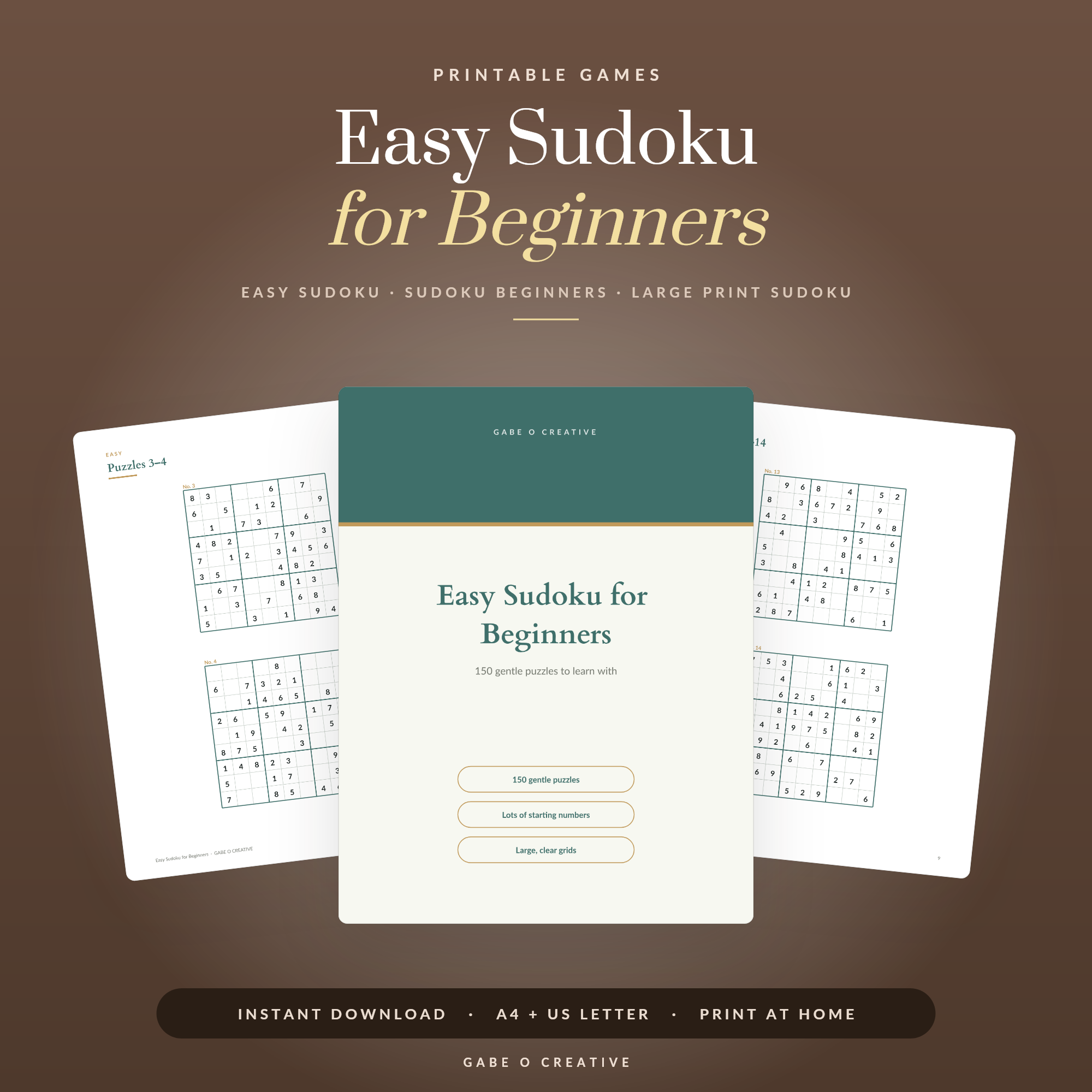
If you've ever looked at a grid of numbers and assumed a sudoku game for beginners requires some knack you don't have, here's the good news: sudoku has exactly one rule, involves no arithmetic whatsoever, and every proper puzzle can be solved by logic alone. The digits could be nine colours or nine letters and nothing would change. What beginners are missing isn't talent — it's three techniques, and you can learn all three in the time it takes to drink a cup of tea. Our Easy Sudoku for Beginners book is built for exactly this stage, with puzzles that reward the techniques rather than punishing you.
Want to start today? Print the easy sudoku puzzles, grab a pencil, and work through the first grid alongside this guide.
 View product →
The One Rule
Fill the 9x9 grid so that every row, every column and every 3x3 box contains the digits 1 to 9 exactly once. That's it. There is no second rule, no special case and nothing hidden.
Everything that follows — every technique, every strategy with an intimidating name — is just a way of noticing where that rule leaves only one possibility. And because the rule works in three directions at once, each square you fill in tells you something about a row, a column and a box simultaneously. That's why sudoku accelerates: the last third of a puzzle takes a fraction of the time the first third did.
Two things beginners assume, wrongly
The first is that maths is involved. It isn't — no addition, no totals, nothing. The second is that you'll eventually have to guess. You won't. A properly constructed puzzle has exactly one solution and a logical path to it, which is worth knowing because the urge to guess is what derails most beginners.
Technique One: Scanning
Scanning is how you solve most of an easy puzzle, and many people never need anything else.
Pick a digit — say 7. Look at where 7 already appears. Each 7 rules out its entire row, its entire column and its whole box. Work through the grid box by box asking a single question: in this box, is there only one square left where a 7 could go? If yes, write it in. Then move to the next digit.
The trick is to start where the grid is fullest. A box with six numbers already in it has far fewer possibilities than one with two, and beginner puzzles are built so that at least one square is always solvable outright. If you're finding nothing, you're almost certainly scanning the empty end of the grid.
Technique Two: The Last Free Square
Any row, column or box with eight digits filled has only one square left — and only one digit missing. Fill it in without thinking.
It sounds too simple to name, but it's the technique beginners forget, because they're busy hunting for something clever. After every few numbers you place, glance across the whole grid for any line or box that's one short. These appear constantly in the second half of a puzzle, and each one you fill often creates two or three more.
 View product →
Technique Three: Pencilling In Candidates
When scanning stops producing anything, switch to candidates. In each empty square, pencil small the digits that could legally go there. It feels slow and it is — but it converts a puzzle you're stuck on into one you can read.
Once the candidates are down, two patterns do most of the work:
- A square with only one candidate — write it in immediately.
- A digit that appears as a candidate only once in a whole row, column or box — it must go there, even if that square has several candidates.
That second pattern is the one that feels like a genuine discovery the first time you use it, and it's the point at which most people start enjoying sudoku rather than enduring it. Erase candidates as you eliminate them, and keep the pencil marks small and in a consistent corner so the grid stays readable.
Choosing the Right Difficulty
The commonest reason people give up is starting too hard. Difficulty in sudoku isn't about how many numbers are given — it's about which techniques the puzzle requires.
| Level | What it needs | Good for |
|---|---|---|
| Easy | Scanning and last free squares only | Learning; building speed and confidence |
| Medium | Candidates, plus the single-candidate patterns | Once easy puzzles take under ten minutes |
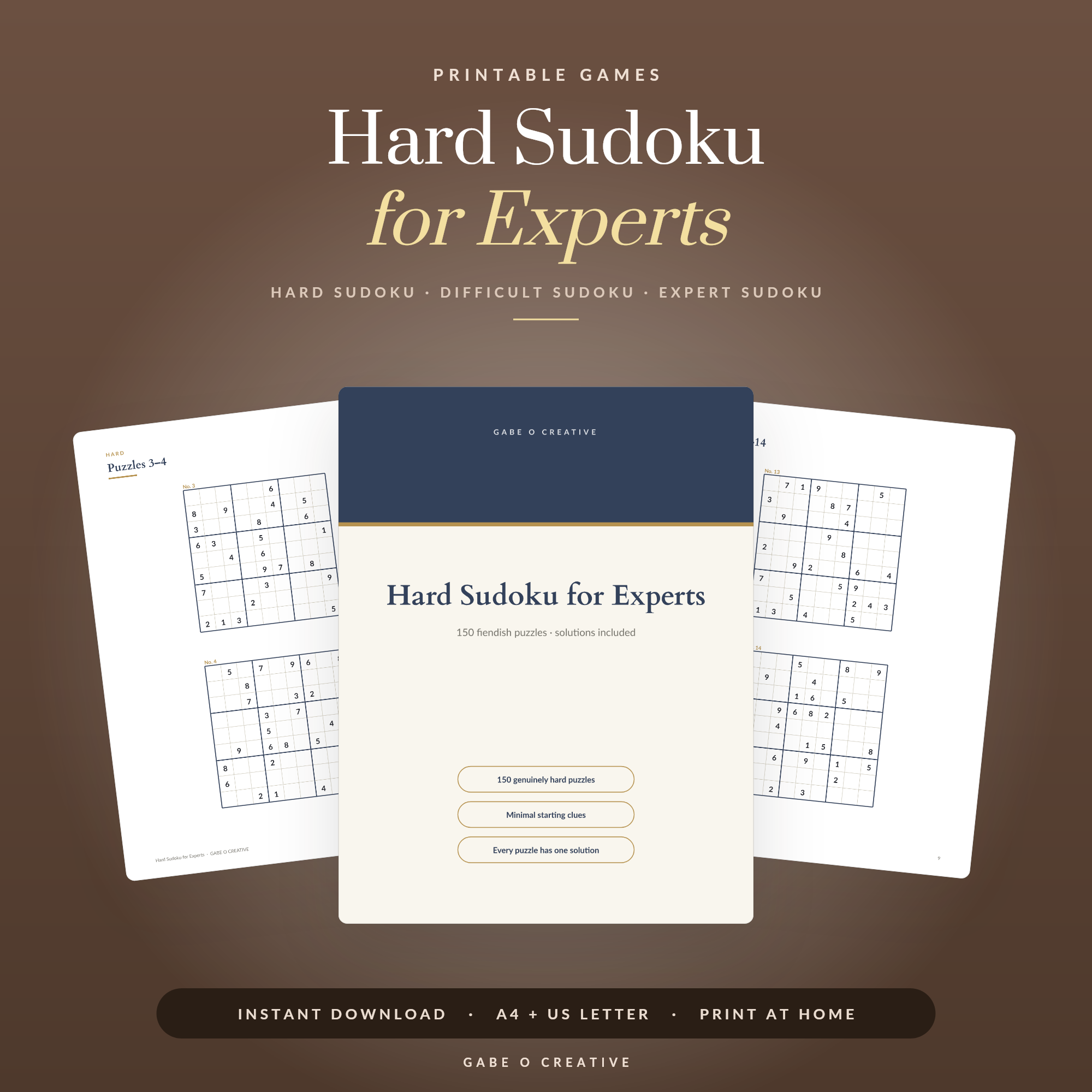
| Hard | Pairs, triples and chains of reasoning | Deliberate practice, not casual solving |
| Expert | Long chains and advanced patterns | Serious enthusiasts only |
Stay on easy until you're finishing consistently without guessing. There's no prize for struggling, and the techniques you build on easy puzzles are exactly the ones medium puzzles assume you already have. When you're ready to move up, the sudoku puzzle book steps through the levels, and the hard sudoku collection is there when medium stops being a challenge.
Why paper beats an app while you're learning
Apps auto-fill candidates and flag mistakes instantly, which feels helpful and quietly removes the two things you're meant to be learning: noticing your own possibilities, and catching your own errors. Printed puzzles make you do both. Once the techniques are automatic, use whichever you prefer.
The Mistakes That Make It Feel Harder
- Guessing. One wrong guess propagates through the grid and can take twenty minutes to unpick — and you often can't tell where it went wrong.
- Writing candidates too large, until the grid is unreadable and you can't see the answers you've already earned.
- Working one region to death instead of moving around the grid as new numbers open things up elsewhere.
- Solving in pen. Use a pencil; the whole method depends on erasing.
- Rushing. Sudoku rewards a careful minute far more than a fast one.
If a puzzle stops making sense entirely, check for a duplicate digit in a row, column or box — that's almost always a slip several steps back rather than a flaw in the puzzle. If you want to vary the routine, the mixed brain games pack alternates puzzle types, and the large print word search is the gentler option for a quiet afternoon. For quieter activities with children, our kids' quiet time activity guide covers the same ground for younger players.
 View product →
Sudoku for Beginners FAQs
What are the rules of sudoku?
There is only one: each row, each column and each 3x3 box must contain the digits 1 to 9 exactly once. Everything else in sudoku follows from that single rule.
Do you need to be good at maths to play sudoku?
No. The digits are just nine different symbols — you could play with nine colours or nine letters instead. Sudoku is pure logic and involves no arithmetic at all.
How do I start a sudoku puzzle?
Scan for the fullest rows, columns and boxes first. The more numbers already placed around a square, the fewer possibilities remain, and beginner puzzles always have at least one square you can solve outright.
Should you ever guess in sudoku?
No. Every properly made puzzle has exactly one solution reachable by logic. If you feel the urge to guess, there's a deduction you haven't spotted — and a wrong guess can take twenty minutes to unpick.
How long should a beginner sudoku take?
Anywhere from ten to thirty minutes at first, dropping to under ten with practice. Speed is the least interesting part; finishing without guessing is the real marker of progress.
What is the best way to practise sudoku?
Regularly and on paper, at a difficulty where you finish most puzzles. Printed books work better than apps for learning because you can pencil in candidates and see your own reasoning.
Ready to solve your first grid? Print the easy sudoku for beginners book and start with technique one, or browse the full Games & Activities collection for puzzle books, word searches and brain games.