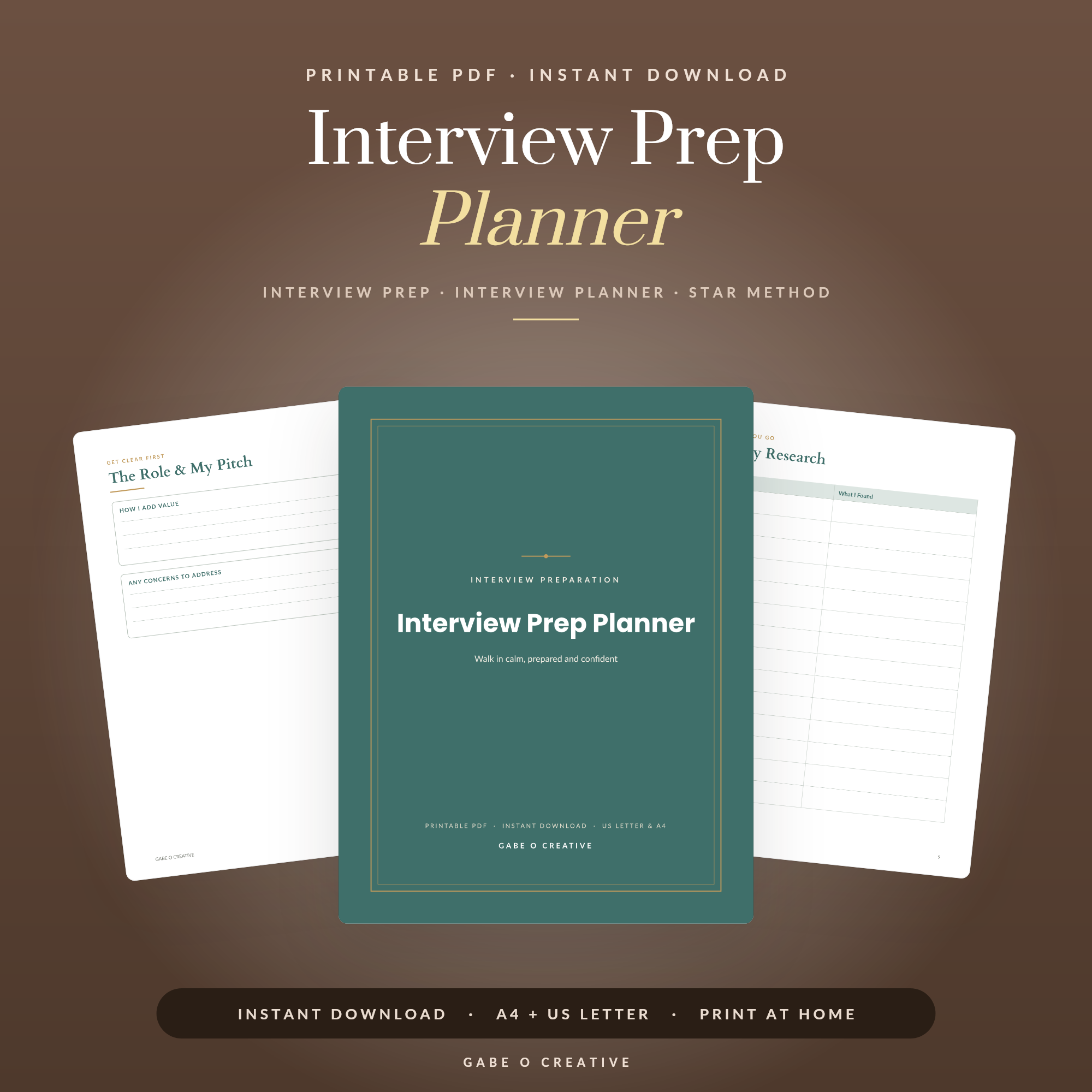
Most interview preparation consists of rereading the job advert until the words stop meaning anything, then lying awake inventing questions you will not be asked. It feels like work and it changes very little. The preparation that actually shifts an outcome is smaller and more specific: a handful of stories, twenty minutes of research, three questions of your own, and a debrief afterwards that makes the next one better. The Interview Prep Planner is laid out around exactly that.
Six Stories, Not Fifty Answers
Competency questions look endless and are not. "Tell me about a time when you handled conflict / missed a deadline / led without authority / dealt with a difficult customer" are four phrasings of a much smaller set of underlying themes.
Pick six examples from your own work that between them cover:
- Something you delivered that mattered
- Something that went wrong, and what you did about it
- A time you disagreed with someone and it worked out
- A time you influenced without being in charge
- Something you learned quickly under pressure
- A time you improved a process, however small
Six stories will cover a large share of what you are asked, because most questions are asking for one of those things in different clothing. Preparing six properly beats preparing thirty badly.
Keep the structure, drop the narration
STAR — situation, task, action, result — is the structure the National Careers Service recommends for these questions, and its advice is to keep examples short and to the point. In practice it is most useful as a brake. The commonest interview failure is not a bad example; it is a good example told for four minutes, with three of them spent explaining the background before you appear in your own story.
Two sentences of context. The bulk on what you did, in the first person. One line on the result, with a number if you have one. Anything longer and the interviewer has stopped listening and started writing.
Twenty Minutes of Research
Not an evening. Three things, and most candidates arrive with none of them:
| What | Where | Why it matters |
|---|---|---|
| How they make money | Their site, an annual report if public | Lets you talk about the role's actual purpose |
| Something recent | News, their blog, LinkedIn posts | One specific reference beats generic enthusiasm |
| Who is interviewing you | Tells you whether to pitch detail or overview |
That last row is underrated. An interview with your prospective manager and one with a department head are different conversations, and knowing which you are in tells you how technical to go before you open your mouth.
Three Questions of Your Own
Prepared, written down, and about the work rather than the holiday allowance. The three that consistently earn their place:
"What does success look like in the first six months?" Their answer tells you what the job actually is, which is frequently not what the advert said.
"What is the team finding hardest at the moment?" You learn the real conditions, and you get a chance to respond to a genuine problem rather than a hypothetical one.
"Why is the role open?" Growth, or someone left? If someone left, the follow-up question is why — asked lightly. This tells you more about the culture than anything else you will hear that day.
Write them down and take them in
Arriving with written questions is normal. Candidates who do look prepared; candidates who freeze at "do you have any questions for us?" look like they had not thought about it, whatever the truth is.
The Question You Cannot Answer
It will happen, and how you handle it is often more informative than the answer would have been.
Say plainly that you have not come across it, then say what you would do to find out — who you would ask, what you would read, how you would test it. Interviewers are rarely checking recall. They are checking whether you bluff, because a colleague who bluffs is a genuine liability and one who says "I do not know, here is how I would find out" is not.
The candidate who improvises confidently and wrongly almost always scores worse than the one who admits the gap.
Video and phone interviews
Increasingly the first round, and the failure modes are different. Test the actual platform beforehand rather than assuming — a link that needs an install five minutes before the call is a genuinely bad start, and it happens more often than you'd think.
Get the camera at eye level, put a light in front of you rather than a window behind, and check what is visible over your shoulder. None of this is vanity: a candidate lit from behind is a silhouette, and an interviewer straining to read your face for forty minutes forms a worse impression without ever knowing why.
One advantage worth using — your notes are off-camera. Your six story prompts and three questions can sit beside the screen where a face-to-face interview would not allow it.
The Debrief Nobody Does
This is one of the most useful fifteen minutes in a job search, and it happens within an hour of walking out.
Write down every question you were asked, as close to verbatim as you can manage. Mark the ones you answered badly. Note anything you promised to send. That is it.
The value compounds: interviews reuse questions relentlessly, both within a company and across an industry. After three interviews you have a list of what is actually being asked in your field, and your fourth interview is prepared against reality rather than guesswork. Few candidates do this, which is why it helps.
Keep it with the application itself. Our guide to organising a job search covers the tracker that holds all of it, and the Job Application Tracker gives every role a row with its own interview notes.
Send the follow-up the same day
Short, specific, and referencing one thing you actually discussed. Not a template. It rarely wins you a job on its own, and it occasionally keeps you in the room when a decision is close.
If the CV and covering letter still need work before you get to this stage, our guide to CVs and cover letters covers that half, and the Resume & Cover Letter Workbook walks through it page by page.
Interview Preparation FAQs
How should I prepare for a job interview?
Prepare six stories, not fifty answers. Most competency questions are variations on a handful of themes, and six well-chosen examples from your own work will cover the majority of them with far less effort than memorising responses.
What is the STAR method?
Situation, Task, Action, Result — a structure for answering 'tell me about a time when'. Its real value is stopping you narrating the whole project: two sentences of context, the bulk on what you did, and one line on the outcome.
What should I research beforehand?
What the organisation actually does and how it makes money, something recent they have announced, and who is interviewing you. Twenty minutes covers all three, and it is more than most candidates arrive with.
What questions should I ask them?
Three, prepared in advance, about the work rather than the perks — what success looks like in the first six months, what the team is struggling with, why the role is open. The last one tells you more than any answer they give about culture.
What should I do immediately after?
Write down the questions you were asked and the ones you answered badly, within the hour. It is one of the most useful fifteen minutes in a job search, because the next interview will reuse most of them and memory fades fast.
How do I handle a question I cannot answer?
Say so, then say what you would do to find out. Interviewers are rarely testing recall — they are testing whether you bluff. A candidate who admits a gap and describes their approach usually scores better than one who improvises confidently and wrongly.
Six stories, twenty minutes of research, three questions, and a debrief afterwards: that is most of the preparation that changes an outcome.