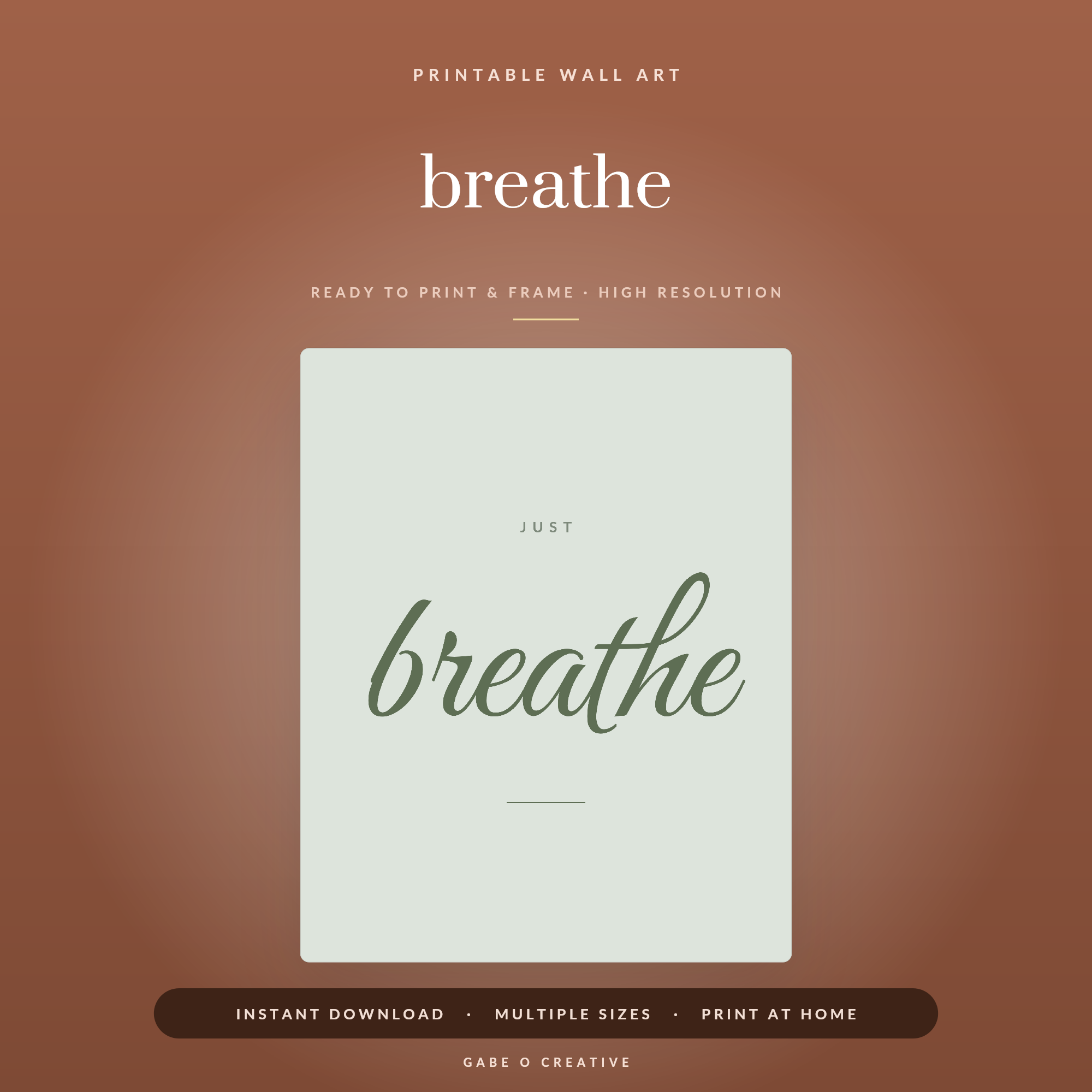
The commonest mistake with printable wall art is buying the frame last. The print arrives, it gets printed on whatever paper is in the tray, and then the search begins for a frame that fits — which is backwards, because the frame is the fixed thing and the print is the flexible one. Get the order right and framing a download is genuinely easy. Get it wrong and you end up trimming a print you paid for. Our printable wall art is supplied in the ratios below for exactly that reason: Breathe, for example, comes as one PDF with 4:5, 3:4, 2:3, 11×14 inch and A-size versions, so you print whichever matches the frame you already have.
The short answer: an A4 print (210×297mm) fits an A4 frame edge to edge. If you want a border, and it usually looks better, buy a larger frame with a mount whose opening is cut for A4. Check the label for "A4" or 21×29.7cm on the mount rather than trusting the frame size alone. "Standard paper" depends on where you are: in the UK and most of the world it is A4, while in the US it is Letter, 8.5×11 inches (about 216×279mm), which fits an 8.5×11 frame rather than an 8×10.
Ratio First, Size Second
This is the single idea that prevents almost every framing problem. A print does not need to match a frame's dimensions — it needs to match its ratio. Get the ratio right and you can print at any size in that family; get it wrong and no amount of scaling helps.
| Ratio | Common sizes | Notes |
|---|---|---|
| A-series (1:√2) | A5, A4, A3, A2 | UK and Europe standard. Each size is double the last |
| 4:5 | 8×10, 16×20 in | Very common in US frames |
| 2:3 | 4×6, 6×9, 12×18 in | Photo ratio, and the one Pinterest recommends for pins |
| 1:1 | Square, any size | Easy to frame, harder to group on a wall |
The A-series has a genuinely useful property: every size is exactly double the one below it, and they all share a ratio. An A4 print scaled to A3 fits perfectly with no cropping. That is not true across ratio families.
A4 is not 8×10
The trap that catches most people. A4 is 210×297mm — about 8.3×11.7 inches. It is taller and narrower than 8×10, and the two are not interchangeable. On a shop shelf they look near enough identical, which is precisely the problem.
If you have an 8×10 frame and an A4 print, you have three options: print smaller and use a mount, trim the print, or buy the right frame. The mount is nearly always the best answer.
What a Mount Actually Does
A mount is the card border sitting between the print and the frame. It is optional, cheap, and the single biggest difference between art that looks printed at home and art that looks bought.
Two reasons it works. It gives the artwork breathing space, so the eye reads it as deliberate rather than as paper filling a frame. And it solves the size mismatch above — a mount lets a smaller print sit correctly inside a larger frame, which means one frame size can hold several print sizes.
Generous beats tight
A 5cm border or more looks considered. A narrow one looks like it came free with the frame. If you are choosing between a bigger frame with a wide mount and a smaller frame with the print filling it, take the first — it will look more expensive from across the room, which is where wall art is actually seen from.
Printing It Properly
Home printers handle A4 perfectly well, and the paper matters more than the printer. Ordinary copier paper is thin and slightly grey; a heavier matte stock costs very little and changes the result completely. Anything from about 160gsm upwards behaves like art paper rather than paperwork.
Two settings do most of the work: print at 100% or "actual size" rather than "fit to page", and choose the correct paper type in the printer dialogue so it lays down the right amount of ink. Fit-to-page is what silently shrinks a print by a few millimetres and leaves it not quite filling the mount.
Above A3, use a print shop
Not a rule about quality so much as practicality — most home printers stop at A4, and large prints on thin paper cockle in the frame. Online print services and high-street shops both produce good results at these sizes for a few pounds, and it is worth it for the one big piece on a wall.
Glass, and why cheap frames disappoint
The other variable nobody mentions. Inexpensive frames usually come with acrylic rather than glass, which is lighter and safer around children but scratches easily and can look faintly cloudy from an angle. Glass looks better and weighs more; acrylic is the sensible choice above a bed or in a child's room.
Either way, take the protective film off both sides before framing. A surprising number of prints end up behind a sheet that still has its factory film on, which is exactly why the finished thing looks slightly hazy and nobody can work out why.
Choosing Sizes for a Wall
For a single print above a piece of furniture, A3 is the usual sweet spot — A4 tends to look lost unless it is one of several. For a group, mix A4 and A3 with one larger anchor piece.
The trick that makes mixed sizes look deliberate rather than accidental: keep the frames consistent and let the mounts vary. Three identical frames holding an A4, an A3 and a square print, each mounted to fill, reads as a set. Three different frames holding three different sizes reads as whatever was in the cupboard.
For the arrangement itself, cut paper templates to each frame size and tape them to the wall first, so you can adjust spacing and height before drilling. Prints like Home Sweet Home and Inhale Exhale share a palette, which makes grouping easier.
Hanging It Without Regret
Two numbers finish the job. Centre the piece at about 145cm from the floor — roughly eye level, and the height galleries use. Above furniture, leave 15 to 25cm between the top of the sofa or sideboard and the bottom of the frame, which is closer than instinct suggests.
For anything heavier than a small A4 frame, find the fixing that suits your wall before you drill. Plasterboard needs a proper anchor rather than a nail, and a frame with glass coming off the wall at two in the morning is a memorable way to learn that.
Frame Size FAQs
What size frame do I need for an A4 print?
An A4 frame if you want the print to fill it, or a larger frame with a mount cut for A4 if you want a border. A4 is 210×297mm, so check the mount opening says A4 or 21×29.7cm. It will not fit an 8×10 frame without trimming or a mount.
What frame size do I need for printable art?
Match the ratio first, then the size. Most printable art is sold in a 2:3 or A-series ratio, and those two are not interchangeable — an A4 print does not fit an 8×10 frame without either trimming the art or leaving uneven gaps.
Is A4 the same as 8×10 inches?
No, and this catches almost everyone. A4 is 210×297mm, roughly 8.3×11.7 inches — taller and narrower than 8×10. They look similar on a shelf and do not swap without a mount or a trim.
What is a mount and do I need one?
A mount is the card border between the print and the frame. You do not need one, but it is the cheapest thing that makes a printed download look bought rather than printed — and it lets a smaller print sit in a larger frame.
Can I print A-sizes on US Letter paper?
Yes, if the file supports both, which good printable art does. Print at the size the frame expects rather than scaling to fit the paper — printing A4 art onto Letter at 100% will crop the edges.
What size should I print for a gallery wall?
Mix A4 and A3 with one larger piece, and keep frames consistent even when print sizes differ. Using the same frame size with different mounts is the easiest way to get variety without the wall looking chaotic.
Where should I get printable art printed?
Home printers are fine to A4 on decent paper. Beyond that, a print shop or online service gives better colour and heavier stock for very little money — and for anything above A3 it is the only sensible option.
Buy the frame first, decide the size and ratio, then print to it.