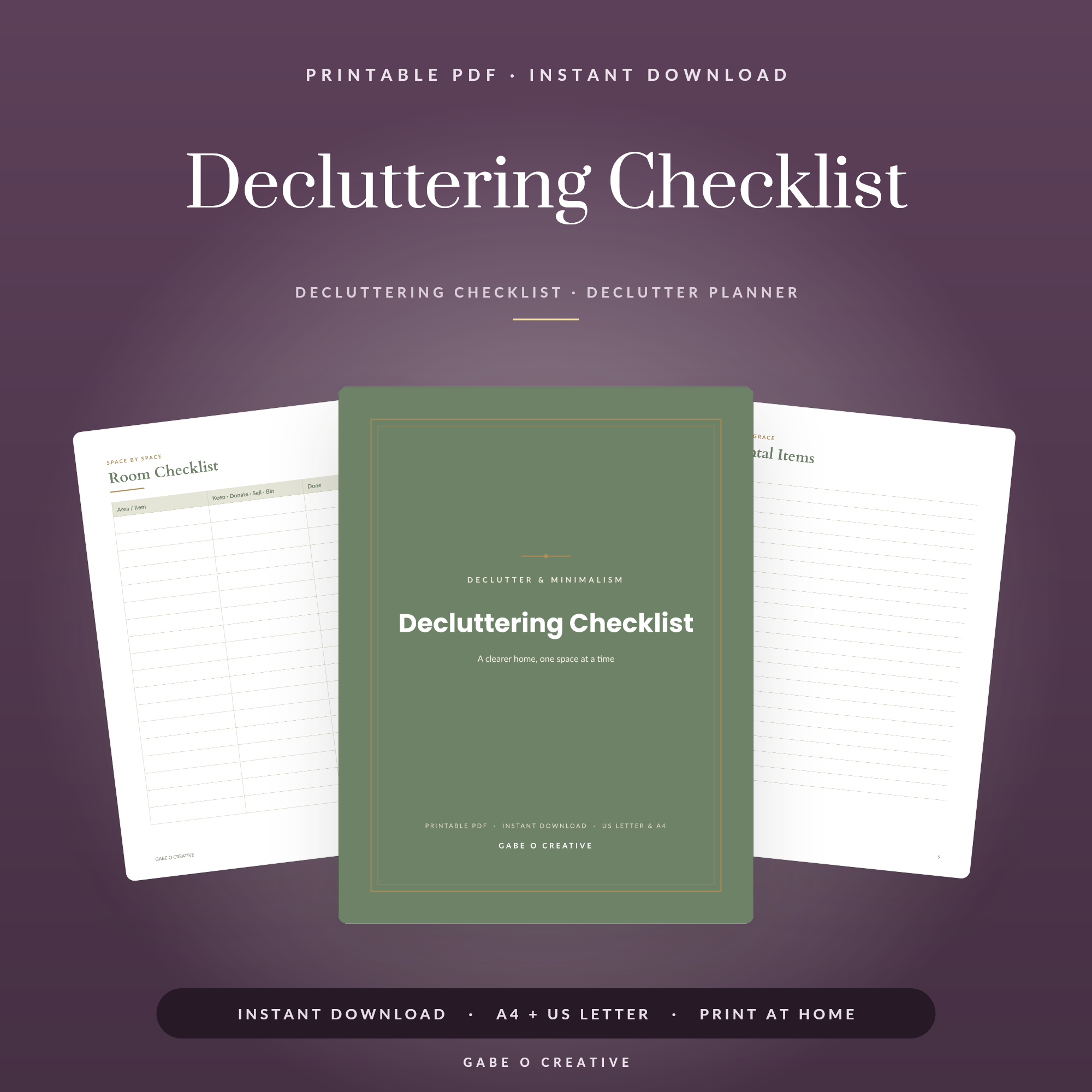
Almost every failed decluttering attempt starts in the same place: the worst room in the house. The loft, the spare room, the garage — the space that has been bothering you for two years. Three hours later you are sitting on the floor with a box of photographs, nothing has left the house, and the conclusion is that decluttering does not work for you. It does. You just started at the hardest possible point. Decluttering room by room works when the order is chosen for decision speed rather than for how much the room annoys you. The Decluttering Checklist is sequenced that way deliberately.
Planning a clear-out? The Decluttering Checklist takes you room by room in an order that builds momentum, with a page per space so you can stop and pick it up again.
 View product →
Start Where Decisions Are Fast
The bathroom is the best starting room in most houses, and it is almost nobody's instinct.
Nothing in it is sentimental. Half of it has an expiry date printed on the side. The decisions are quick, obvious and largely made for you, which means you finish a whole room in thirty minutes and feel the effect immediately. That feeling is the actual product of the first session — you are training the decision-making muscle, not clearing the most stuff.
| Start here | Leave until later |
|---|---|
| Bathroom cabinet | Loft and garage |
| Kitchen drawers | Photographs and letters |
| Under the sink | Children's artwork |
| Coat cupboard | Inherited belongings |
| The car | Anything belonging to somebody else |
That last row is a genuine rule rather than a preference. Decluttering someone else's possessions without asking damages relationships far more than the clutter was costing you, and it makes them defensive about everything afterwards.
Or start with a single drawer
If a whole room feels like too much, do one drawer. Twenty minutes, finished, visibly better. The goal on day one is not volume — it is proving to yourself that the process ends in a result, because the belief that it does is what gets you back to it on Saturday.
The Four Boxes
Set up four containers before you start: keep, donate, bin, relocate.
The relocate box is the one that changes how a session goes. Without it, every item belonging in another room sends you out of the room — and once you are in the kitchen you start tidying the kitchen, and the original drawer is still open two hours later. With it, you stay put, finish the space, and distribute the box at the end.
Get the bags out of the house that day
Donation bags that live in the hall for three weeks quietly get reopened. Things come back out. Put them in the car immediately, and drop them off within a day or two — the decision is only really made when the items are gone.
Defer Everything Sentimental
One labelled box, and you deal with it last. Possibly much later.
Sentimental decisions are slow and genuinely draining, and mixing them into a general session is the commonest reason a session collapses. You are twenty minutes in, going well, and then you find a card from someone who died — and the afternoon is over, reasonably enough.
Keeping them in one place is also honest about what you are doing. Most people are not trying to get rid of meaningful things; they are trying to get rid of the eleven identical vases and the cable drawer. Separating the two lets you be decisive about the vases without feeling you are being asked to discard your history.
When you do get to it, the useful question is not "does this matter?" but "does keeping thirty of these honour it more than keeping three?" Photographing things you are letting go of works well for a lot of people — the memory is in the image, not the object.
 View product →
Sessions, Not Marathons
Twenty to forty minutes, one defined area, then stop.
Decision quality falls off a cliff after about an hour. Past that point people start keeping things purely because deciding has become tiring — which is the opposite of the point, and it means a long session can leave you with more kept than a short one would have.
Defining the area beforehand matters as much as the timer. "The bedroom" is not an area; "the top two drawers" is. A finished small space is worth far more than an abandoned large one, because the visible result is what brings you back.
The paperwork exception
Paper is the one category that genuinely needs a system rather than a session, because most of it has to be kept and the question is where rather than whether. Our guide to the staying on top of life admin covers the system side, and the Important Documents Organiser gives it a home so it stops being a decluttering problem at all.
Two questions that speed everything up
When an item stalls you, one of two questions usually unsticks it. Would I buy this again today? cuts through the sunk cost of what it originally cost — the money is gone either way, and keeping it does not bring it back.
The second is more practical: could I replace this in twenty minutes for under a tenner? If yes, and you have not used it in a year, the storage is costing you more than the replacement would. That one clears an enormous amount of 'might need it someday' without any agonising.
Keeping It That Way
Decluttering is an event. Staying decluttered is a habit, and the habit is much smaller than people fear.
One in, one out on the categories that multiply — clothes, mugs, toys, cables, tote bags. Not everything, just the things that visibly breed.
Ten minutes a week. One reset, same slot, putting things back where they live. Ten minutes weekly comfortably outperforms four hours quarterly, because it never accumulates to the point of being daunting.
Notice the surfaces. Flat surfaces are the early warning system — the kitchen counter, the dining table, the chair in the bedroom. When those start collecting, something has stopped having a home, and finding out what takes five minutes.
For the wider household systems that keep it from returning, the Household Binder covers the admin side, and our home organisation printables guide covers the rest of the house.
Decluttering FAQs
Where should I start decluttering?
The bathroom, or a single drawer. Start somewhere with fast, obvious decisions and almost no sentiment — you are building momentum and learning to decide, not clearing the most cluttered space first.
Why is the loft the wrong place to start?
Because it is the highest-sentiment, lowest-decision-speed room in the house. People start there because it is the worst, spend three hours on one box of photographs, and conclude that decluttering does not work for them.
What is the four-box method?
Four containers as you work: keep, donate, bin, and relocate. The relocate box is the important one — it stops you leaving the room every time you find something belonging elsewhere, which is what turns an hour into a whole day.
What do I do with sentimental items?
Defer them. Put them in one clearly labelled box and deal with them last, or not at all. Sentimental decisions are slow and emotionally expensive, and letting them interrupt a session is the commonest way a session ends early.
How long should a decluttering session be?
Twenty to forty minutes. Long enough to finish a defined area, short enough that decision quality holds. Past about an hour most people start keeping things purely because deciding has become tiring.
How do I stop clutter coming back?
One in, one out on categories that multiply — clothes, mugs, toys, cables — plus a single weekly ten-minute reset. Decluttering is an event; staying decluttered is a habit, and the habit is much smaller than people expect.
Start with the bathroom cabinet tonight. Twenty minutes, four boxes, bags in the car — then work the rooms in order with the Decluttering Checklist, or browse the full Home & Organization collection.
Once the clutter is out, a room-by-room cleaning schedule covers what to actually clean and how often in the space that is left.