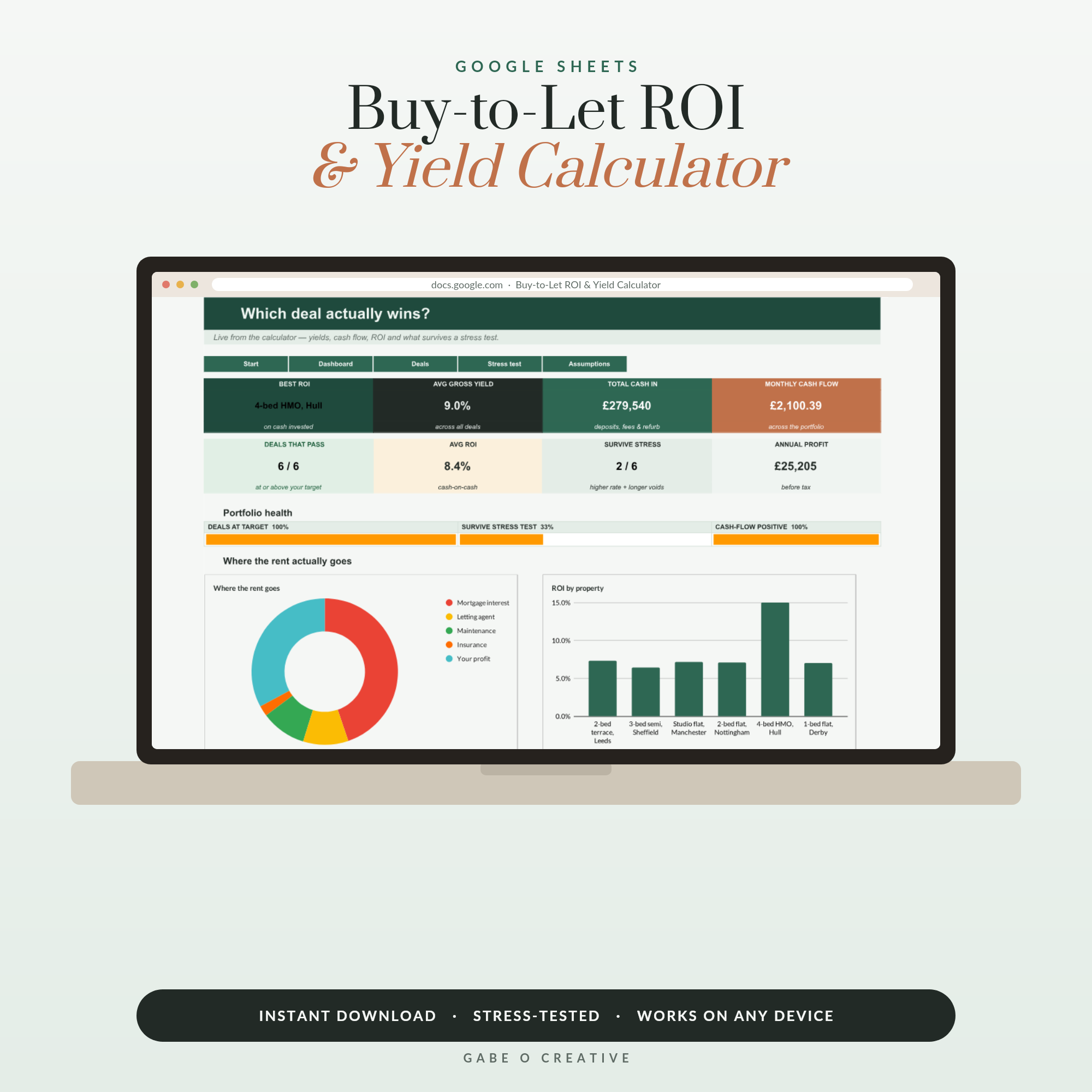
Knowing how to calculate rental yield properly is the difference between comparing deals correctly and copying whatever number an estate agent's listing quotes. That number is almost always gross yield - annual rent divided by property price - and gross yield ignores your mortgage, your fees and the actual cash you put in. Two properties on an identical 6% gross yield can return 3% and 9% on your money. Our buy-to-let ROI calculator works out the number that actually separates them.
Looking at a listing today? Calculate the gross yield first - it takes ten seconds - then don't stop there. The next two numbers are what tell you whether it's actually a good deal for you specifically.
 Shop Landlord Rental Property Spreadsheet Google Sheets, Income & Expense Tracker, Multi-Property Dashboard, Tenant Register & Tax-Ready Summary →
How to Calculate Rental Yield: The Number Everyone Quotes
Gross yield is simple by design: annual rent divided by property price, as a percentage. A property renting at GBP1,000 a month (GBP12,000 a year) priced at GBP200,000 has a gross yield of 6%.
- It's fast - which is exactly why every listing leads with it.
- It ignores costs entirely - no maintenance, no letting agent fees, no void periods, no mortgage.
- It ignores how you're financing the purchase - cash buyer or heavily mortgaged, gross yield reads identical.
Useful as a first filter to rule properties in or out quickly. Not useful as the number you make a purchase decision on.
The formula, if you want to check one by hand
Annual rent / property price x 100. A GBP1,200/month rental on a GBP180,000 flat: (1,200 x 12) / 180,000 x 100 = 8% gross yield. Thirty seconds with a calculator - the harder part is what comes next.
Gross Yield vs Net Yield: Where the First Correction Happens
Net yield subtracts real running costs from the rent before dividing: maintenance, insurance, letting agent fees (typically 10-15% of rent if you use an agent), and an allowance for void periods between tenants.
| Gross yield says | Net yield usually shows |
|---|---|
| 8% (GBP1,200/month, GBP180,000 flat) | Often 6-6.5% once agent fees and a realistic maintenance allowance are subtracted |
| 6% (GBP1,000/month, GBP200,000 house) | Often 4.5-5%, wider gap if the property needs more upkeep |
Net yield is always lower than gross, typically by 1-2 percentage points. It's a more honest number - but it still says nothing about how the purchase is financed, which is where the real gap between two similar-looking deals opens up.
Cash-on-Cash Return: The Number That Actually Ranks Deals
Cash-on-cash return is annual profit after the mortgage payment, divided by the cash you actually put in - deposit plus buying fees, not the full property price. This is where two properties with an identical gross yield stop looking the same.
A property bought with a 25% deposit and a property bought in cash can both show 6% gross yield, but return very different amounts on the money you actually risked. The mortgaged property uses far less of your cash, so the same rental profit is a much larger percentage return on that smaller base - unless the mortgage rate eats too much of the margin, in which case it can go the other way just as sharply.
Why this catches people out
Most rental yield discussions stop at gross or net yield because they're simpler to calculate. Cash-on-cash return needs the mortgage terms, the deposit size and the fees all in one place - which is exactly what a proper calculator handles, and what a quick mental estimate rarely gets right under time pressure with an estate agent waiting for an answer.
 Shop Net Worth Tracker Google Sheets, Personal Finance Dashboard with Monthly Snapshots, Asset & Debt Tracker, FI Progress Spreadsheet →
What Counts as a Good Rental Yield in the UK
Gross yields of 5-8% are typical outside London and the South East. In London and the South East, 3-5% gross is more common, because property prices are high relative to achievable rent.
But a 7% gross yield bought with a large, expensive mortgage can still be a mediocre cash-on-cash return - and a modest-looking 4% gross yield bought with a small deposit and a good rate can outperform it on actual money returned. The regional benchmark tells you if a deal is roughly in range; cash-on-cash return tells you if it's right for your specific finances.
Stress-Testing Before You Commit
A deal that only works in the best-case scenario isn't a deal, it's a bet. Before treating any yield number as final, check what happens at a higher interest rate than today's and with a realistic void period (most portfolios see at least 2-4 weeks a year between tenants, more in some areas).
If the numbers only work at the current rate with zero voids, that's worth knowing before exchange, not after the first rate rise or the first empty month. For tracking a property once you've actually bought it - rather than deciding whether to - our landlord spreadsheet guide and the rental property tracker cover the ongoing side: income, expenses, and the same yield figures recalculated on real numbers instead of estimates. It's usually one of the largest single numbers in a household's finances too, worth tracking alongside the rest with a net worth tracker once you own it, rather than in isolation.
 Shop All-in-One Personal Finance Dashboard, Google Sheets Budget Template, Net Worth, Debt Payoff & Savings Goal Tracker →
Rental Yield Calculator FAQs
How do you calculate rental yield?
Gross yield is annual rent divided by property price, shown as a percentage - a GBP1,000/month rental on a GBP200,000 property is 6% gross yield. This is the number almost every listing quotes, and it is also the least useful one, because it ignores the mortgage, fees and deposit that determine what you actually earn on your own money.
What is the difference between gross yield and net yield?
Gross yield ignores costs entirely. Net yield subtracts annual running costs (maintenance, insurance, letting agent fees, void periods) from the rent before dividing by property price. Net yield is always lower than gross, often by 1-2 percentage points, and it is the more honest of the two - but neither accounts for how the purchase was financed.
What is cash-on-cash return and why does it matter more?
Cash-on-cash return is annual profit after the mortgage payment, divided by the actual cash put in (deposit plus fees) - not the full property price. Two properties with an identical 6% gross yield can return 3% and 9% on your money once financing is factored in, because one used a larger deposit or a cheaper mortgage rate. It is the number that actually ranks deals against each other.
What is a good rental yield in the UK?
Gross yields of 5-8% are typical outside London and the South East, where 3-5% is more common due to higher property prices relative to rent. But a 'good' gross yield on a property bought with a large mortgage can still be a poor cash-on-cash return - always check both before deciding a deal is good.
Why do two properties with the same yield give different returns?
Because yield only measures the property, not how you paid for it. A property bought in cash and one bought with a 75% mortgage can show identical 6% gross yield, but the mortgaged property returns far more (or far less) on the actual cash invested, once interest and fees are subtracted from a much smaller cash base.
Should I use a spreadsheet to check rental yield before buying?
Yes - a calculator that handles gross yield, net yield and cash-on-cash return in one place removes the arithmetic that most people skip under time pressure when a listing looks good. A stress test (what happens at a higher interest rate or three months void) catches deals that only work in the best-case scenario.
Run the numbers before you commit. The buy-to-let ROI calculator handles gross yield, net yield and cash-on-cash return in one sheet, or browse the full Google Sheets collection.