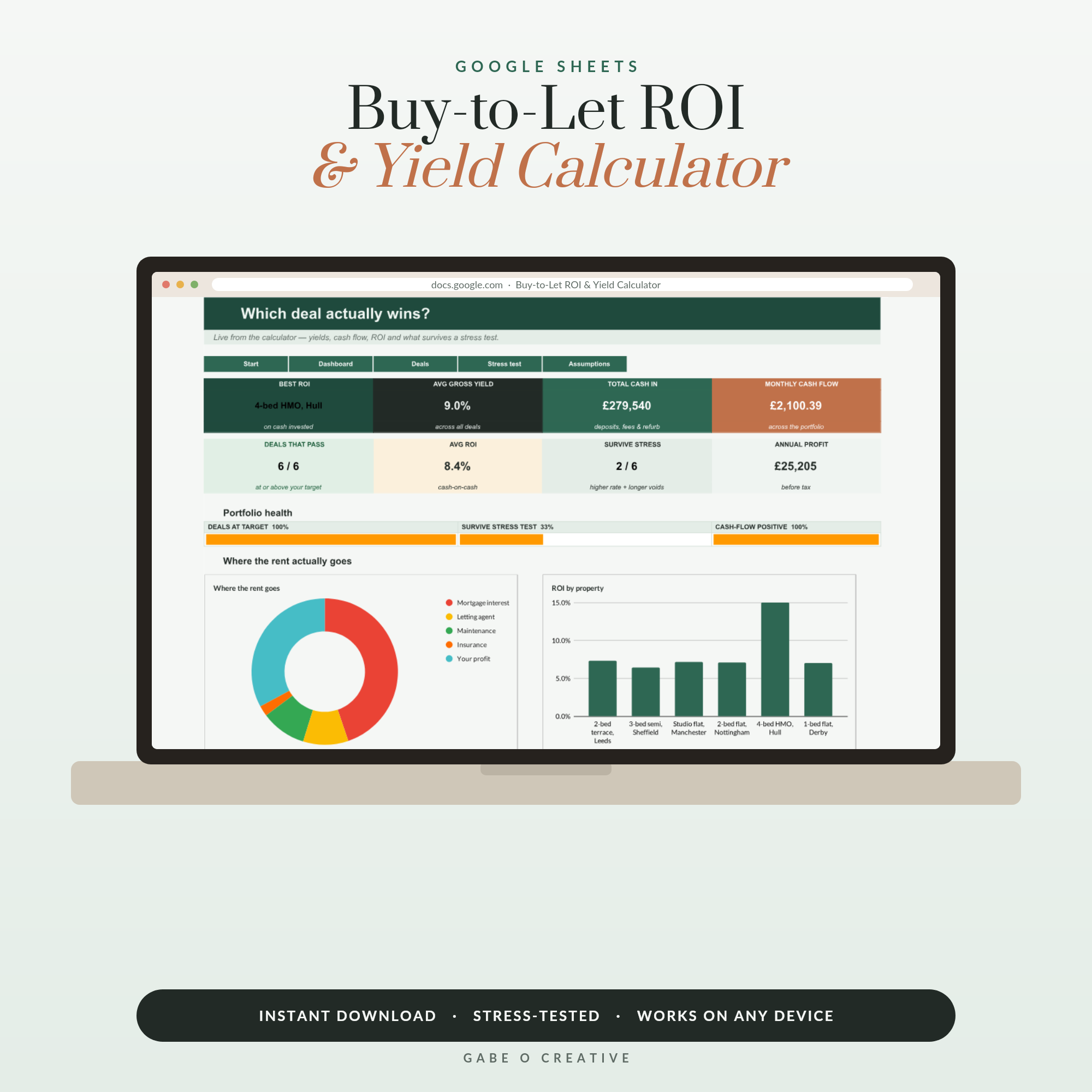
Rental yield is the number every listing quotes, every agent leads with, and almost nobody uses correctly. It is genuinely useful — as a filter for deciding what to view. It is close to useless as a reason to buy, because it deliberately ignores the two things that determine what you actually earn: your mortgage and the cash you put in. Understanding which of the three yield numbers to use, and when, is most of the skill. The Buy-to-Let ROI & Yield Calculator works all three out at once if you would rather not.
Sizing up a property this week? The Buy-to-Let ROI & Yield Calculator takes the price, deposit and expected rent and returns gross yield, monthly cash flow and true cash-on-cash return — with a stress test.
 View product →
Gross Yield: The Filter
Annual rent ÷ purchase price × 100.
A £145,000 terrace let at £950 a month earns £11,400 a year, so: 11,400 ÷ 145,000 = 7.9 per cent gross.
That took ten seconds, which is exactly what it is for. Gross yield lets you dismiss nine listings out of ten before you have spent an evening on any of them. What it cannot do is tell you whether the tenth is worth buying, because it assumes a world with no letting agent, no boiler, no empty months and no mortgage.
Why the north/south gap is not free money
Gross yields are structurally higher where prices are lower — parts of the north routinely show 8 per cent against 4 or 5 in the south east. That is not a discovery, it is arithmetic, and it usually comes with slower capital growth and different tenant demand. A high gross yield is a prompt to look closer, not a verdict.
Net Yield: The First Honest Number
(Annual rent − running costs) ÷ purchase price × 100.
Take the same terrace. Letting agent at 10 per cent is £1,140. Maintenance allowance at 10 per cent is another £1,140. Landlord insurance, say £300. Two weeks of void costs about £438. Running costs land near £3,018.
(11,400 − 3,018) ÷ 145,000 = 5.8 per cent net.
Two percentage points have vanished, and nothing has gone wrong yet — that is simply what it costs to let a property. Most people quoting yields at you are quoting the 7.9, not the 5.8.
Cash-on-Cash: The One That Ranks Deals
Annual profit after everything, including mortgage interest, ÷ the cash you actually put in.
Deposit at 25 per cent is £36,250. Buying costs around 3 per cent are £4,350. Say £6,000 of refurbishment. You have put in £46,600. The mortgage on £108,750 at 5.5 per cent costs £5,981 a year in interest.
£11,400 − £3,018 − £5,981 = £2,401 profit. Against £46,600 in, that is 5.2 per cent cash-on-cash.
Here is the whole point of the article in one table:
| Measure | This property | What it tells you |
|---|---|---|
| Gross yield | 7.9% | Whether to bother viewing |
| Net yield | 5.8% | What the bricks really earn |
| Cash-on-cash | 5.2% | What your money earned |
Two buyers can look at that same property and get completely different cash-on-cash returns depending on their deposit, their rate and what they spend doing it up. Yield cannot see any of that. It is the only one of the three that ranks deals against each other, and it is the one nobody quotes.
The number behind the number
Cash flow matters as much as the percentage. £2,401 a year is £200 a month — real, but thin enough that one boiler ends the year at a loss. A deal can show a respectable return and still be uncomfortable to own, and the monthly figure is what tells you that.
Stress-Test It Before You Offer
Run every deal again with the rate two points higher and voids at eight weeks rather than two. On our terrace, interest rises to £8,156 and rent after longer voids falls to about £10,646 — profit drops to roughly minus £528. It goes from modest to loss-making on a change that has happened twice in recent memory.
That is not an argument against buying it. It is an argument for knowing that before you offer rather than after. Deals that survive the stress test are the ones you can hold through a bad year; deals that only work at today's rate are a bet on rates staying still.
What every yield figure hides
Three things sit outside all three calculations, and each can matter more than the percentage.
Capital growth. Yield measures income only. A 4 per cent yield in an area appreciating steadily can beat an 8 per cent yield somewhere flat, and neither number will tell you that. They answer different questions and you need both.
Time. A property needing a full refurbishment, chasing a difficult tenant, or managed yourself rather than by an agent costs hours that never appear in a spreadsheet. If you have costed an agent at 10 per cent and then self-manage to save it, you have not saved anything — you have hired yourself, and usually cheaply.
Concentration. Four flats in one building at 7 per cent is not the same risk as four houses in four towns at 6 per cent, even though the arithmetic looks better. One local employer closing, one block-wide cladding bill, one council licensing change hits all four at once.
None of that argues against calculating yield. It argues against treating the highest number on a page as the answer.
Once You Own It
Yield is a decision tool. After completion, what matters is recording what actually happened — real rent received, real repairs, real void weeks — because the second property you buy should be priced on your own data rather than an agent's estimate.
Our guide to building a landlord spreadsheet for rental income and expenses covers that side, and the Landlord Rental Property Tracker does it for you across multiple properties. For the tax end of it, landlord allowable expenses explains which of those running costs you can actually deduct — which quietly changes your real return again.
Rental Yield FAQs
How do you calculate rental yield?
Gross yield is annual rent divided by the purchase price, times 100. A £145,000 property let at £950 a month gives £11,400 a year, which is a 7.9 per cent gross yield. It is the quickest number to work out and the least useful one to decide on.
What is the difference between gross and net yield?
Gross yield uses the rent before any costs. Net yield subtracts the running costs — letting agent, maintenance, insurance, void periods — before dividing. Net is usually two to three percentage points lower, and it is the first honest number in the chain.
What is a good rental yield in the UK?
Broadly, 5 to 6 per cent gross is typical in southern England and 8 per cent or more is achievable in parts of the north. But a headline yield says nothing about your mortgage or the cash you put in, so treat it as a filter for viewing, not a reason to buy.
Why doesn't yield account for my mortgage?
Because yield is a property-level measure, not an investor-level one. It describes what the bricks earn against their price, regardless of who financed them. Two buyers paying different deposits on the same property get identical yields and very different returns.
What is cash-on-cash return?
Annual profit after every cost and mortgage interest, divided by the cash you actually put in — deposit, buying costs and refurbishment. It is the only one of the three that answers what your money earned, which is why it should rank your deals.
Should I stress-test a yield before buying?
Yes. Rerun the numbers with the mortgage rate two points higher and voids at eight weeks instead of two. Deals that still work under that are real; deals that only work at today's rate are a bet on rates, not an investment.
This is a modelling guide, not financial, mortgage or investment advice. Every figure depends on the assumptions you enter — take professional advice before buying.
Run your next deal properly. Open the Buy-to-Let ROI & Yield Calculator, enter the price, deposit and rent, and see all three numbers plus the stress test — or browse the full Google Sheets collection.