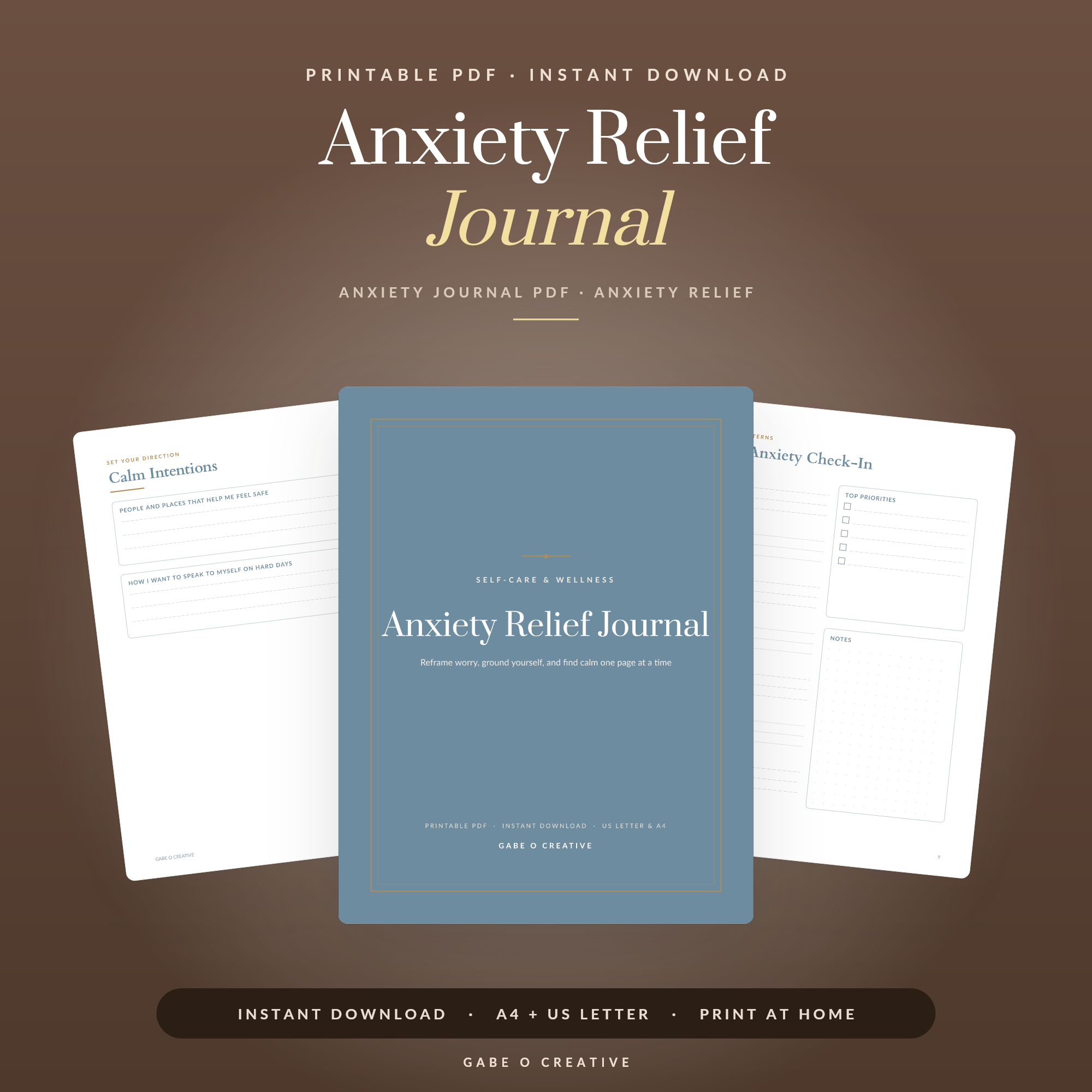
Most anxiety advice quietly assumes a calm starting point. Sit down, reflect on the underlying belief, notice the pattern — all reasonable, and all extremely difficult at the moment you most need help, because the part of your brain that does reflection is the part that has gone offline. A useful anxiety workbook is built the other way round: short exercises that work when you are already in it, and longer ones for when you are not. The Anxiety Relief Journal is laid out in that order deliberately.
Want something to hand on a hard day? The Anxiety Relief Journal has grounding pages, thought records and a what-has-helped-before page — print it and keep it somewhere you will reach for it.
 View product →
Start Physical, Not Insightful
When it is already bad, the exercises that work are the ones that require almost nothing of you.
- 5-4-3-2-1. Five things you can see, four you can hear, three you can touch, two you can smell, one you can taste. It works because it is boring and specific.
- Longer out-breath. Breathe in for four, out for six or seven. The out-breath is the part that does the calming; most breathing advice overcomplicates this.
- Cold water. On the wrists or the face. Unsubtle, and it genuinely interrupts the physical loop.
- Move. Two minutes of walking, even indoors. Anxiety is a body state as much as a thought state.
Why insight comes second
Asking "what is the evidence for this thought?" is a genuinely powerful question and a completely useless one at peak anxiety, because you cannot access the evidence. Do the physical thing first, then the thinking exercise twenty minutes later when there is someone home to do it. Workbooks that lead with insight get abandoned by people who tried them on a bad day and concluded they do not work.
The Written Exercises Worth Having
Once you are steady enough to write, four pages do most of the work.
| Exercise | What it does | When |
|---|---|---|
| Thought record | Separates the thought from the fact | Afterwards, calm |
| Worry list + worry time | Postpones rather than suppresses | As worries arrive |
| What helped before | Removes the need to remember | Written once, read often |
| Trigger log | Reveals patterns you cannot feel | Weekly, briefly |
The "what helped before" page is the one to write first, and almost nobody does. On a bad day you will not remember that the walk helped in March, or that phoning your sister worked in June. A short list, written when you are well, means you do not have to solve the problem from scratch every time — you just read it and pick one.
Worry time, properly
Pick fifteen minutes at a fixed point — not right before bed. When a worry arrives during the day, write one line and note that it belongs to worry time. Then, at that time, sit with the list deliberately.
Two things usually happen. Some worries have resolved themselves and look faintly silly written down. The rest get proper attention rather than being half-thought about all day. The mechanism is postponement rather than suppression, and that distinction is why it works when "stop worrying" does not.
Paper Beats a Screen Here
Not a preference — a practical difference. Paper is slower, which suits an exercise whose purpose is slowing down. It has no notifications on it. And nothing you write is being stored anywhere, which matters more than people admit when the thing you need to write is embarrassing or frightening.
The slowness is the point. Typing a worry takes four seconds and feels much like thinking it. Writing it by hand takes twenty and forces the vague dread into an actual sentence — and a surprising number of them shrink noticeably in that translation.
 View product →
Little and Often Beats a Session
The instinct is to do a big session when things are bad. In practice five minutes most days works better than an hour occasionally, for the same reason a physiotherapy exercise does.
Keep it undemanding enough to survive a bad week. Two lines is a completed entry. A workbook you use badly is enormously more useful than one you use perfectly for nine days and then abandon with a page of unfinished worksheets reproaching you every time you see it.
Track lightly, if at all
A daily 1-to-10 rating is enough to spot a pattern over a month. Anything more elaborate turns into monitoring, and monitoring anxiety closely tends to increase it. If tracking is making you more watchful of yourself rather than less, stop — that is a real result, not a failure.
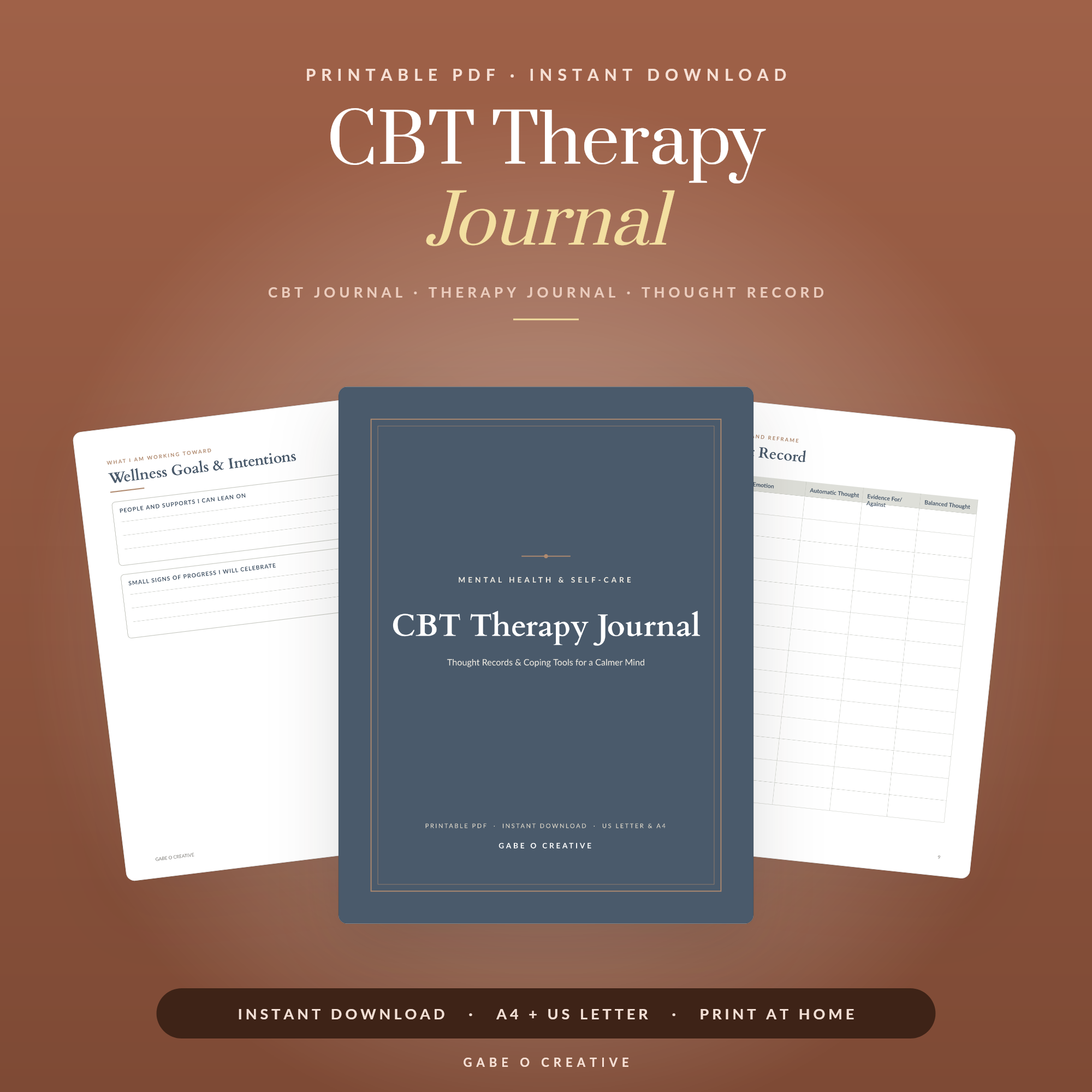
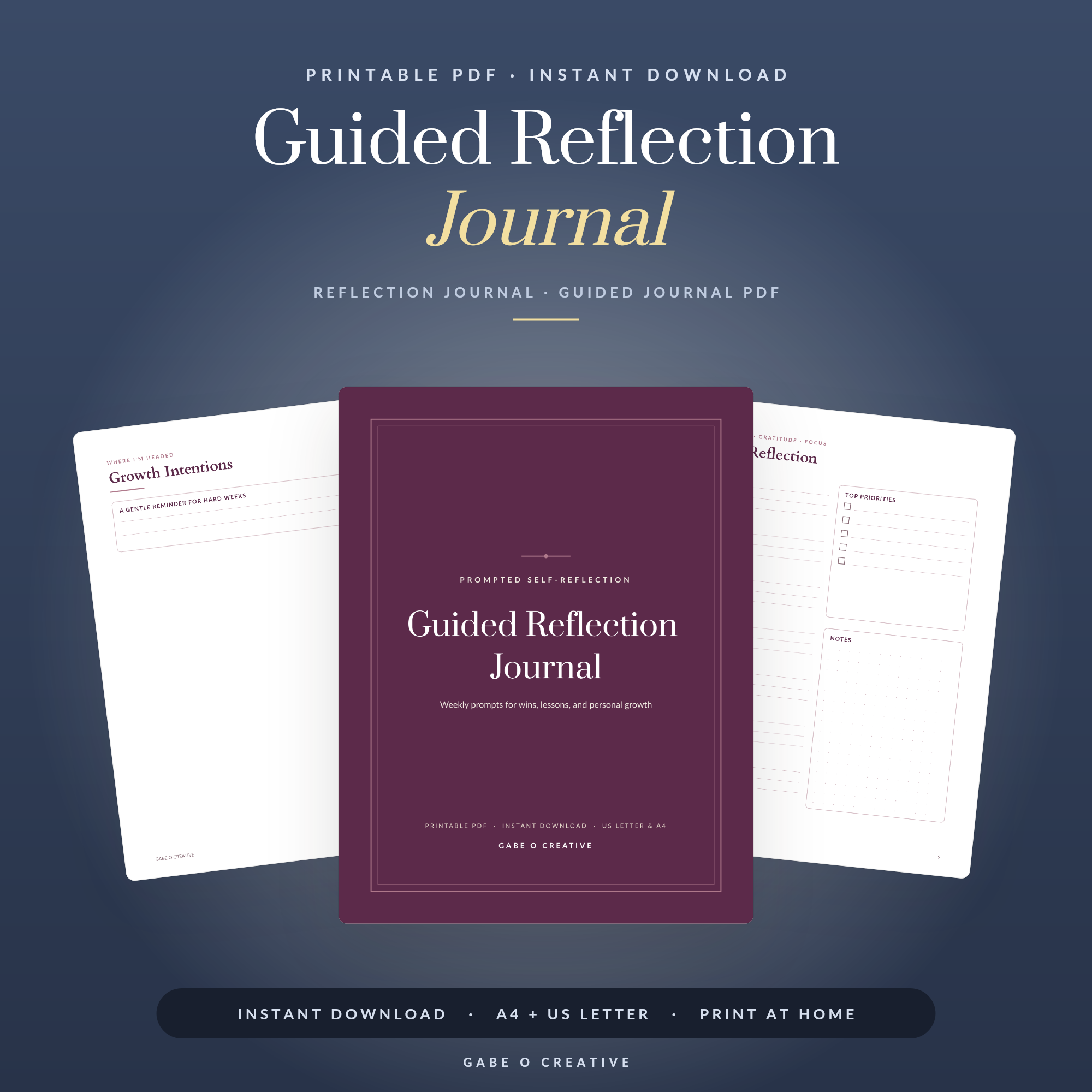
If a structured approach appeals, the CBT Therapy Journal follows the thought-record method more formally, and our guide to CBT thought records explains how to fill one in. For something gentler and less clinical, the Guided Reflection Journal uses prompts rather than worksheets.
Sleep and caffeine do more than any worksheet
Worth saying plainly because it is unglamorous. Anxiety and poor sleep feed each other, and caffeine has a longer half-life than most people assume — a mid-afternoon coffee is still measurably in your system at bedtime.
If you are doing the written work and nothing is shifting, look at those two before concluding the exercises are not for you. Neither is a cure, and both change the baseline you are working from. It is difficult to reason your way out of a physical state you are actively topping up.
When a Workbook Is Not the Answer
This matters more than anything else on the page, so it is not buried at the bottom as a disclaimer.
Self-help worksheets are a companion to support, not a replacement for it. Speak to your GP or a qualified professional if anxiety is affecting your sleep, work or relationships, if it has lasted weeks rather than days, if you are avoiding things you used to manage, or if it is getting worse rather than steadier. None of that means the workbook was wrong — plenty of people use one alongside therapy, and having a record of what has been happening makes that first conversation considerably easier.
If you are in crisis or thinking about harming yourself, contact your local emergency services or a crisis line now rather than working through a page.
Anxiety Workbook FAQs
What goes in an anxiety workbook?
Short written exercises rather than long reflection: a grounding page, a thought record, a worry list with a time attached, and a page of what has helped before. The last one is the most useful and the one people leave out.
Why does writing things down help?
It moves a worry from a loop into a fixed form. A thought circling in your head can repeat indefinitely; the same thought written on paper is finite, and often looks noticeably smaller once it has to be a sentence.
What is worry time?
Setting aside fifteen minutes at a fixed point in the day to worry deliberately, and deferring worries to it as they arise. It sounds odd and works better than trying to suppress them, because you are postponing rather than refusing.
What can I do when it is already bad?
Something physical and small — the 5-4-3-2-1 grounding exercise, a slow breath out for longer than the breath in, cold water on your wrists. Insight exercises need a calm brain; grounding exercises do not, which is why they come first.
Do printable worksheets actually help?
For many people, yes — largely because paper is slower than a screen and has no notifications on it. They are a self-help tool, not treatment, and they work best alongside support rather than instead of it.
When should I speak to someone?
If it is affecting sleep, work or relationships, if it has lasted weeks rather than days, or if you are avoiding things you used to manage. A workbook is a good companion to that conversation and a poor substitute for it.
This article is general wellbeing information, not medical advice, and nothing here is a substitute for speaking to a qualified professional about your own situation.
Write the what-helped-before page today, while things are steady. Open the Anxiety Relief Journal and start there — or browse the full Self-Care & Wellbeing collection.