Morning pages get recommended so often that most people never hear an actual explanation of what they are — just "you should try morning pages," as though the name alone is self-explanatory. It mostly isn't, and the gap between the vague idea and the real practice is exactly why so many people try it for three days and quietly stop. Julia Cameron, who created the practice for her book The Artist's Way, describes it on her own website in one plain sentence: "three pages of longhand, stream-of-consciousness morning writing about absolutely anything." Every part of that sentence is doing real work, and it's worth taking apart properly.
"Three pages" — a length, not a word count
The measure is pages, not words. Write in a way that naturally fills roughly a US Letter or A4 page and three pages becomes a real but bounded task — long enough that you write past the obvious surface thoughts, short enough to actually finish most mornings. Counting words instead misses the point: the length exists to force you past what you already knew you were thinking, into whatever comes after that runs out.
"Longhand" — handwritten is the original design, not a suggestion
Cameron's original practice specifies handwriting, not typing. The reasoning most commonly given for this is that handwriting is slower than typing, and that slower pace is what stops the editing brain from getting ahead of the thought — typing is fast enough to draft and revise almost simultaneously, which is exactly the self-censoring the practice is trying to bypass. Plenty of people successfully adapt morning pages to typing because it's the version they'll actually keep doing, which is a reasonable trade-off to make deliberately — but it is a trade-off, not a neutral substitution, and it's worth trying the handwritten version at least once before assuming typing works just as well for you.
"Stream-of-consciousness" — no editing, no rereading, no plan
This is the part people quietly break first, usually by trying to write something worth rereading. The practice works specifically because nothing on the page has to be good: whatever crosses your mind goes down, including the mundane, repetitive, or embarrassing parts, and none of it gets revised as you go. If you genuinely can't think of anything, "I don't know what to write" is itself a valid line — the point is that the page keeps filling, not that it fills with anything worthwhile.
| Rule | What breaks it | Why the rule exists |
|---|---|---|
| Three pages | Stopping at a paragraph because you've "said everything" | The useful material usually shows up after the obvious thoughts run out |
| Handwritten | Typing, then editing as you go | Slower writing outruns the urge to self-censor |
| No rereading | Going back to fix a sentence or check what you wrote | Rereading turns free writing into drafting, which defeats the purpose |
| First thing in the morning | Doing it at night once the day has already shaped your thinking | The point is to clear the mind before the day's obligations take over it |
Starting tomorrow, not "eventually"
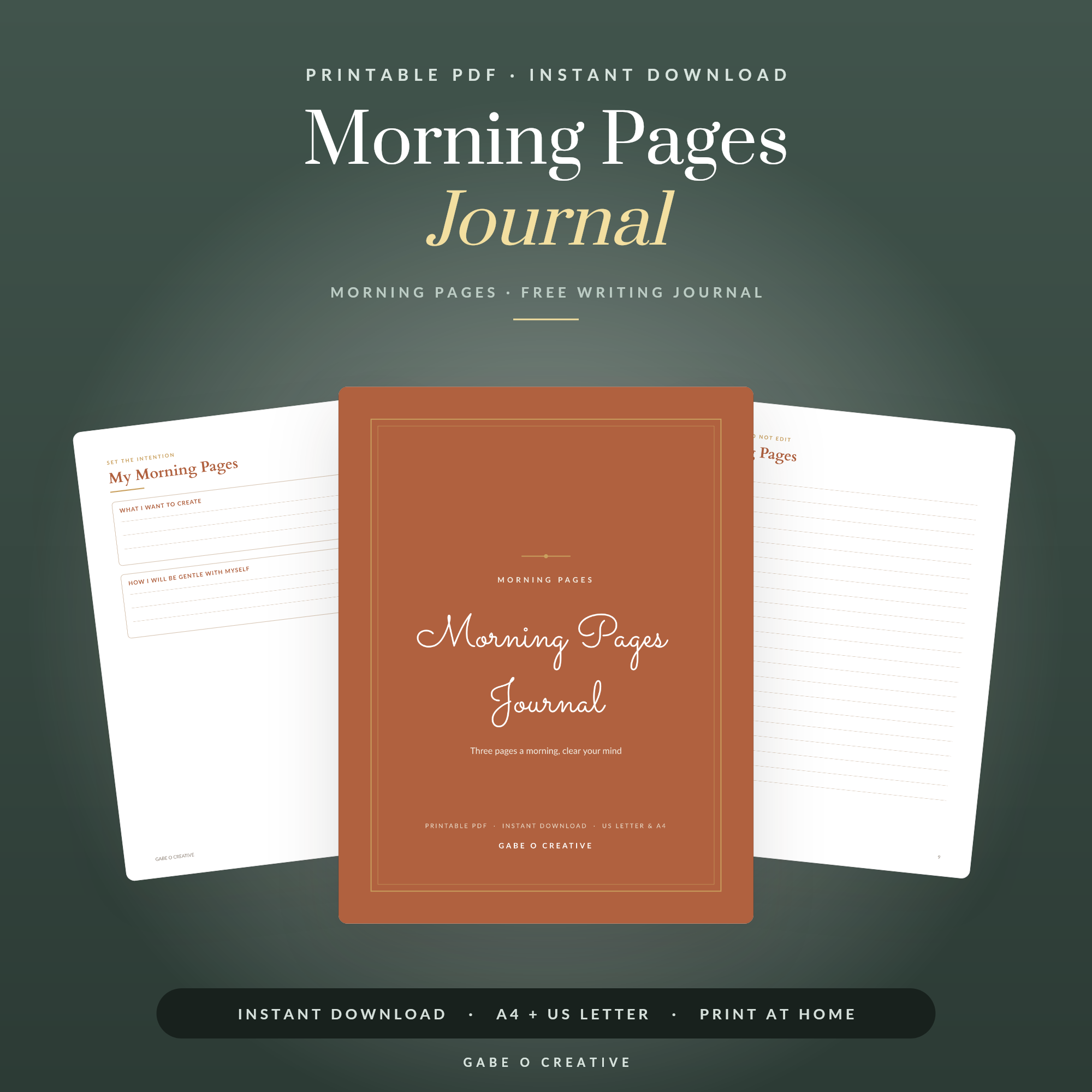
The practical version: three pages, by hand, before checking a phone or starting the day properly, written without stopping to fix anything, for as many mornings in a row as you can manage. The Morning Pages Journal gives that structure a home — daily free-writing pages sized for the practice, gentle prompts for the mornings nothing comes to mind, and a weekly reflection page for looking back without breaking the no-rereading rule on the pages themselves.
If gratitude is more your entry point than free writing, a daily gratitude journal is a gentler, more structured cousin of the same daily-writing habit. And if what actually needs clearing out is a specific pattern rather than a general mental backlog, a shadow work journal covers that more targeted version of the same underlying idea — write it down rather than carry it around unexamined.