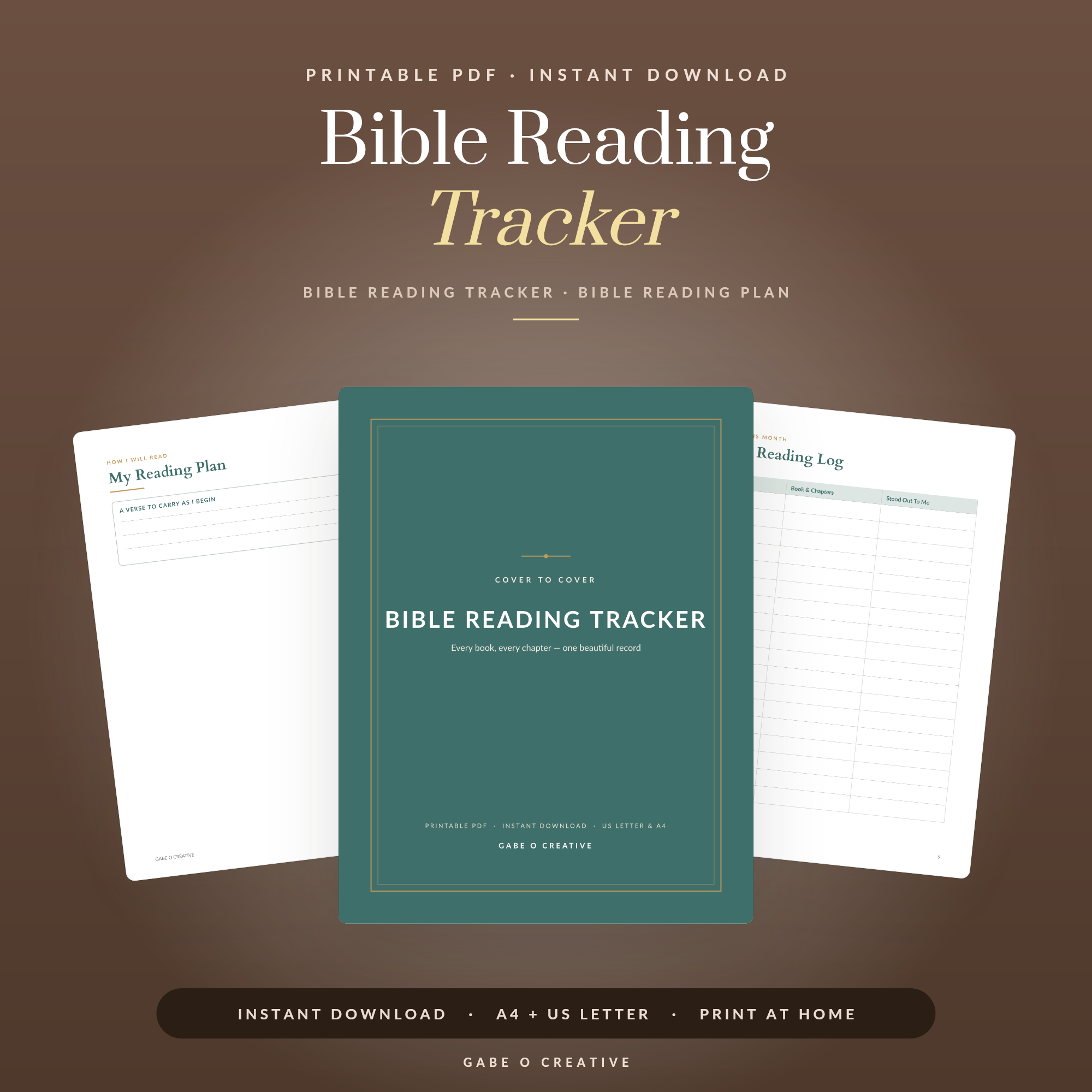
Almost every bible reading plan for beginners fails in the same place: somewhere in Leviticus, in February. The plan wasn't wrong so much as badly shaped — it started at page one, demanded four chapters a day, and left no room for a week when life got in the way. A plan you finish beats an ambitious one you abandon, and shaping it properly takes about ten minutes. Our printable Bible reading tracker covers every book and chapter so you can see progress rather than guess at it.
Starting this week? Print the reading tracker, pick a Gospel, and tick the first chapter tonight.
 Shop Bible Study Journal →
Don't Start at the Beginning
Reading front to back is the single commonest reason people stop. Genesis and Exodus are gripping; Leviticus is a legal code for a society that no longer exists, and hitting it in week five with no context is what ends most attempts.
A better order for a first read:
- Mark — the shortest Gospel, fast-moving, and the clearest picture of who Jesus was.
- Acts — what happened next, and reads like a travel narrative.
- Philippians — short, warm, and a gentle introduction to the letters.
- Genesis — now you have context for what the whole story is building towards.
- Psalms and Proverbs — dip in alongside anything else; they don't need to be read in order.
Save Leviticus, Numbers and the longer prophets until you actually want to understand the machinery. There's no rule that says you must read every book before you read any book twice.
Choosing a Plan Shape
| Plan | Daily load | Suits |
|---|---|---|
| One chapter a day | 5–10 min | Almost everyone starting out |
| New Testament in a year | ~1 chapter | A first full-year goal that's achievable |
| Whole Bible in a year | 3–4 chapters | Second or third time round, not the first |
| Chronological | 3–4 chapters | People who want the history to make sense |
| Themed (a month per theme) | 1 passage | Reading for a particular season of life |
Be honest about the daily load. Fifteen minutes at the same time every day beats an hour twice a week, because it becomes automatic rather than something you schedule. A chapter a day gets you through the New Testament in under nine months — genuinely more than most people manage with a more ambitious plan.
Pick a translation you enjoy reading
The best translation for a beginner is the one you don't have to fight. Modern readable versions are easier to sustain than more literal ones; you can always compare later. If a passage feels impenetrable, reading it in a second translation often solves it faster than a commentary would.
 Shop Scripture Writing Plan →
Building the Habit
- Attach it to something you already do — the first cup of tea, the train, after the children are in bed. New habits fixed to existing ones survive; free-floating ones don't.
- Set the book out the night before, open at the right page. Removing friction matters more than motivation.
- Read first, study later. Don't stop to look up every name on your first pass.
- Write one line — a question, something you noticed, someone to pray for. One line, not a page.
- Tick it off. Visible progress is genuinely motivating, and it's why a tracker beats a bookmark.
That last step does more work than it looks like. A tracker with three months of ticks is quite hard to abandon, whereas a bookmark tells you nothing about how far you've come. If you want to slow down further and pay closer attention, our scripture writing plan guide covers copying verses by hand, which is the most effective way to actually notice what a passage says.
When You Miss a Week
You will, and this is the moment that decides whether the plan survives.
Do not read the backlog. Pick up from today's date and carry on. A reading plan is a rhythm, not a debt — treating missed days as arrears turns a quiet practice into an accusation, and that is precisely how people end up abandoning it and feeling guilty about the Bible in general.
If you've missed a month, don't restart from January either. Start today, in whatever book the plan is on. The aim is to still be reading in a year's time, and a year of imperfect weeks is worth more than six flawless ones followed by nothing.
When it feels dry
Everyone hits stretches where nothing lands. Usually it means the passage needs context rather than that something is wrong with you — genealogies and legal codes are not designed for a five-minute morning read. Move to a different book for a fortnight and come back. Consistency matters more than sequence.
Once questions start accumulating, that's the point to add structure: the Bible study journal gives you somewhere to work them through, and our guide to starting one covers the method. If prayer is the part you'd like to build alongside the reading, the prayer journal and our prayer journal guide pair naturally with a morning routine, and the faith and prayer bundle collects the tracker, journals and plans together.
 Shop Prayer Journal →
How to Read a Chapter Without Drifting
The other common failure isn't missing days — it's reading a chapter and reaching the end having absorbed none of it. Four small habits fix most of that, and none takes extra time.
- Read the first sentence twice. It sounds trivial and it settles your attention more reliably than anything else.
- Notice who is speaking and to whom. A remarkable amount of confusion comes from assuming a line is addressed to you when it was said to a specific person in a specific situation.
- Watch for the joining words. "Therefore", "but", "so that" carry the argument, and skimming reads straight past them. If you see a "therefore", look back and ask what it's there for.
- Stop at one question. Write it down rather than chasing it immediately. Questions that accumulate over a week are the ones worth taking to a study Bible or a person.
Read out loud when it stops going in
Most of these texts were written to be heard rather than read silently, and reading a paragraph aloud slows you to roughly speaking pace — which is about a third of skim-reading speed. It feels self-conscious for the first minute and then stops feeling odd. It is the single most effective fix for reading without absorbing, and costs nothing.
One book at a time beats a bit of everything
Jumping between a Psalm, a Gospel and a letter each morning feels varied but makes it hard to follow any thread. Reading a single short book straight through over a fortnight gives you something a scattered plan never does: a sense of what that writer was actually arguing.
Bible Reading Plan FAQs
Where should a beginner start reading the Bible?
Not Genesis to Revelation. Start with one of the Gospels — Mark is the shortest and quickest-moving — then Acts, then a letter like Philippians. Genesis and Exodus read well after that.
How long should I read each day?
Ten to fifteen minutes is plenty and is far more sustainable than an hour you manage twice. A chapter a day finishes the New Testament in under nine months.
Do I have to read the Bible in a year?
No, and for a first attempt it's often the wrong goal. A year plan means roughly four chapters daily with no room for a bad week — which is why so many end in February.
What do I do if I miss a week?
Start again from today's date rather than reading the backlog. Catch-up guilt ends far more reading plans than busyness does, and the missed passages will come round again.
Should I use a chronological or a standard plan?
Chronological plans put events in the order they happened, which helps the history make sense. Standard plans follow the book order. Either works — pick one and don't switch halfway.
Do I need a study Bible or commentary?
Not to begin with. Read first and let questions accumulate; a study Bible is more useful once you have real questions than as another thing to buy before starting.
Start tonight. Print the Bible reading tracker and tick your first chapter, or browse the full Faith & Christian collection for journals, trackers and reading plans.