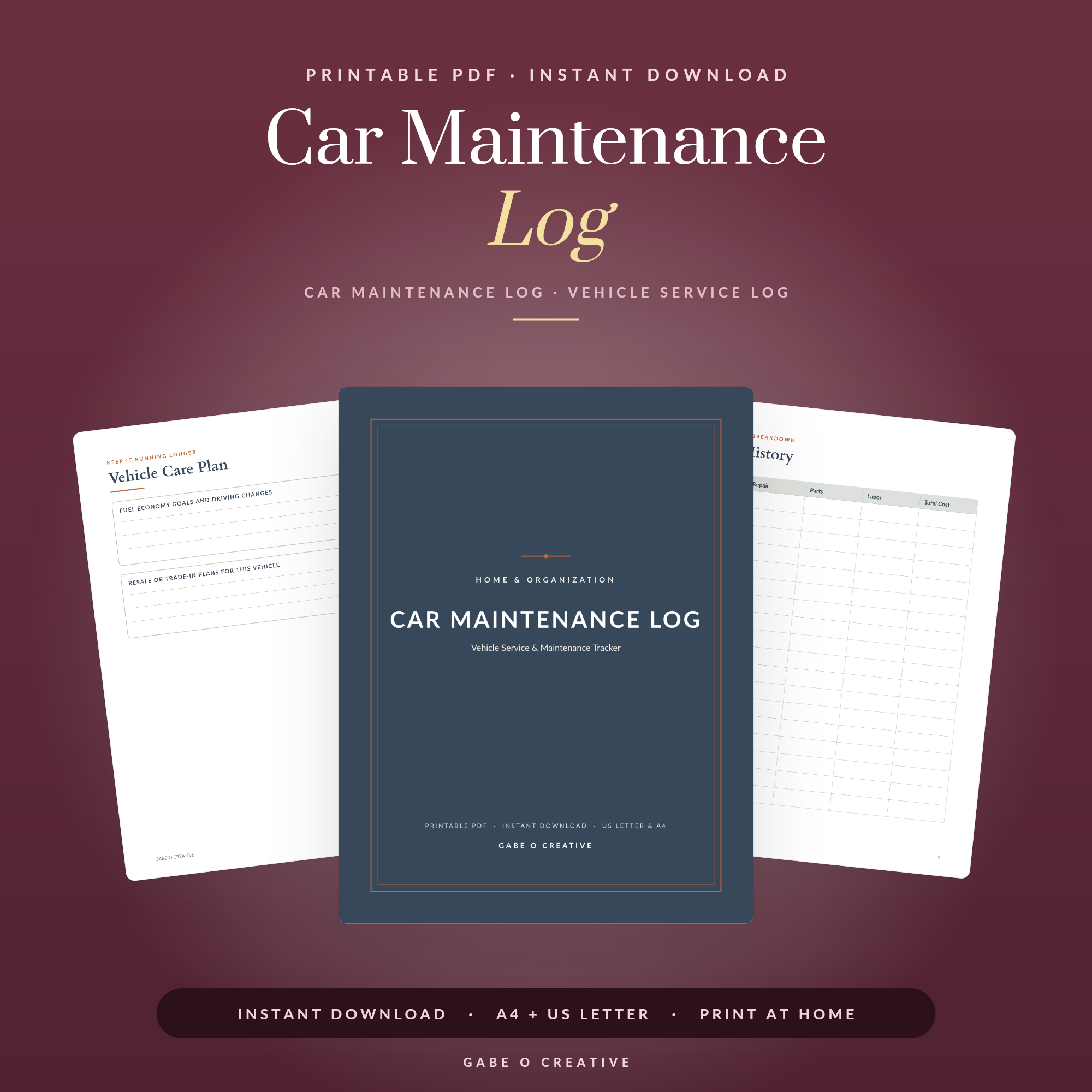
A car maintenance log is only useful if two things are true: it actually gets filled in, and it holds the right information when someone needs it — a mechanic asking when the cambelt was last done, an insurer asking about service history, or a buyer at resale wanting proof the car was looked after. Most car owners have some version of this scattered across paper receipts in the glovebox and a vague memory of "sometime last spring." A log fixes the second problem. The habit of actually updating it is the harder one, which is easier to build once the checks it's built around have a real schedule rather than a vague "now and then."
Tyres: check every two weeks, wherever you drive
According to the AA's car maintenance guidance, tyres — including the spare — should be checked every two weeks, because tyres naturally lose pressure over time even without a puncture. Two things to check each time:
| Check | What to look for | UK standard | US standard |
|---|---|---|---|
| Pressure | Compare to the figure in the door sill or handbook | Every 2 weeks (AA) | Monthly and before long trips (AAA) |
| Tread depth | Legal minimum across the central 3/4 of the tyre | 1.6mm legal minimum; 3mm recommended in winter (RAC) | 2/32” legal minimum in most states; AAA’s own recommendation is to replace nearer 4/32” rather than wait for the legal floor |
The RAC's guidance on regular car checks is explicit that 1.6mm is the UK legal minimum, not a target to aim for — 3mm in winter gives meaningfully better grip in wet or icy conditions. AAA’s tread depth guidance makes the same point for the US: 2/32” is where tyres become illegal, not where they stop being worth replacing — AAA recommends checking with a quarter rather than the traditional penny test, since a tyre that fails the penny test is already unsafe by the time it does. Either way, treat the legal number as the point you should already have acted, not the one to wait for.
One note for anyone reading this from the US: UK car owners will also see the annual MOT test referenced elsewhere online, which has no single US equivalent — safety and emissions inspection rules are set state by state over there, so check your own state DMV rather than assuming a national standard.
Oil: follow the handbook, not a fixed number
The AA's general guidance suggests an oil change roughly every 6,000 miles, but the same page is clear that the manufacturer's own handbook should be the actual reference — some modern engines and oil types are rated for considerably longer intervals, and following a generic number instead of the handbook risks either wasting money on early changes or, worse, going too long between them. What's worth logging either way: the date, the mileage at the time, and the mileage the next change is due, so the answer to "when was this last done" doesn't depend on memory.
Full service: every 12,000 miles or 12 months, whichever comes first
For a professional service rather than a DIY check, the RAC's car service checklist puts the standard interval at 12,000 miles or 12 months, whichever comes first — and notes this matches what most manufacturers themselves recommend. A full service is considerably more than an oil change: it covers brakes, suspension, wheels, engine, fluids, oils, steering, tyres and lights as a full safety-system check, not just the parts that wear out fastest.
What actually belongs in the log
Beyond the three checks above, a log that holds up at resale or for a mileage claim needs a few more things recorded consistently:
- Vehicle details — make, model, VIN and registration, so the log is unambiguous if it's ever handed over with the car.
- Every service and repair — date, mileage, what was done, cost and who did it. This is the single biggest thing a private buyer or a dealer will ask to see.
- Fuel and mileage — useful for tracking MPG over time (a real drop can flag a developing fault before it becomes an expensive one), and essential if any of the mileage is being claimed for work or tax purposes.
- Registration and insurance renewal dates — not maintenance exactly, but the same admin habit, and easy to forget until a reminder letter arrives.
The Car Maintenance Log is built around this exact list — a service log, an oil change tracker with next-due reminders, a fuel log with MPG worked out automatically, tyre rotation tracking, and a registration/insurance reminders page, so none of it depends on remembering to check the AA or RAC guidance again next time.
Keep it with your other household admin
A car maintenance log solves one specific admin problem; most households have several more sitting in the same drawer. If registration and insurance documents for the car (and everything else) tend to go missing at the exact moment they're needed, an important documents organiser is the wider version of the same habit. Anyone insuring the car itself will also want a record of what's actually in it and the house — a home inventory for insurance covers that side, and if a house move is coming up, a moving house checklist covers the admin that a car log alone won't.