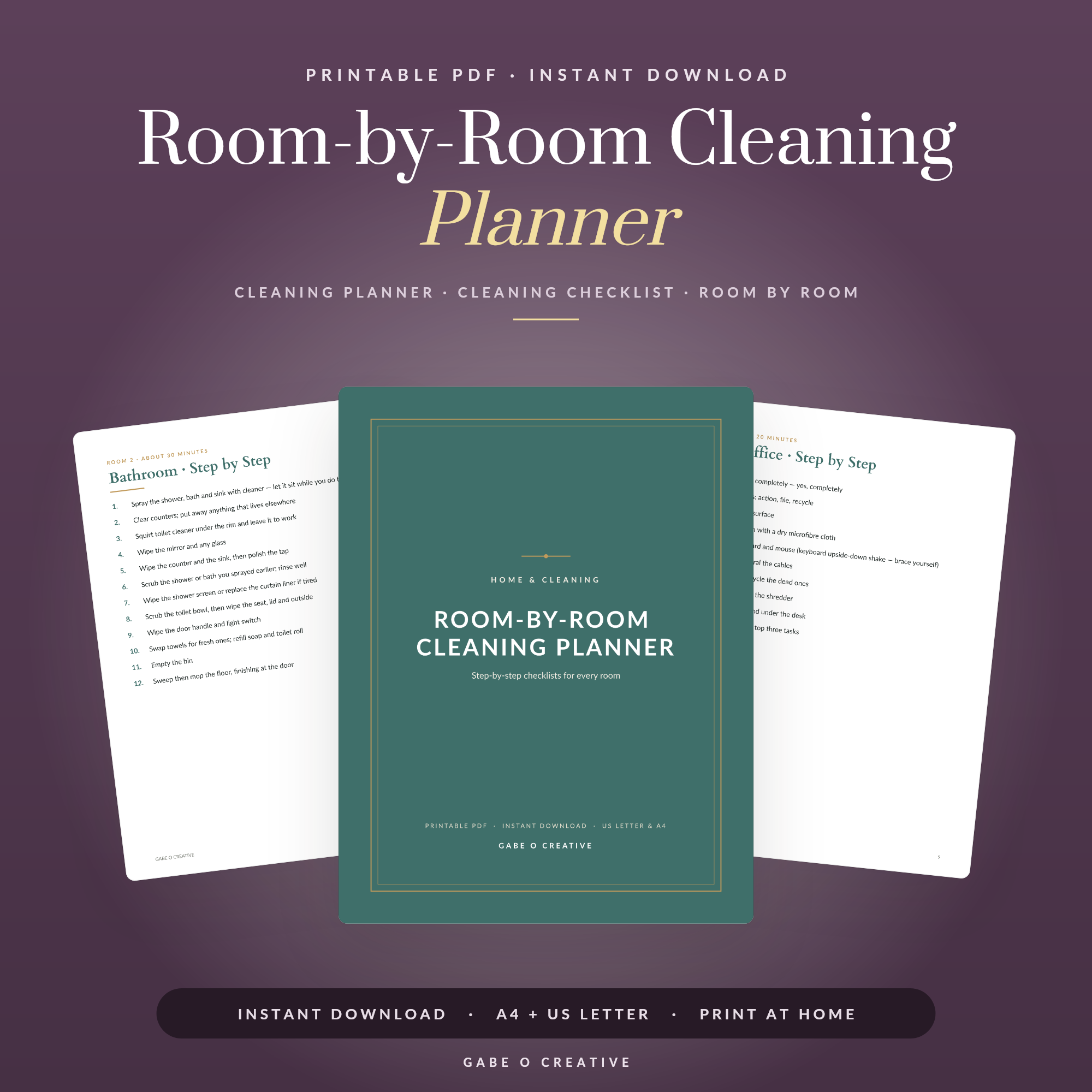
Most cleaning schedules assign a day of the week to the whole house: Mondays for laundry, Wednesdays for bathrooms, and so on. The problem is that rooms don't get dirty on a weekly rhythm. A kitchen sink handles food and bacteria every single day; a spare bedroom that nobody sleeps in most weeks barely changes between one clean and the next. A schedule built by room rather than by day matches the cleaning to what the room actually needs, which is also how the food-safety and public-health guidance below is written — by task and surface, not by day of the week.
The Room-by-Room Cleaning Planner is built around this idea: nine numbered checklists (kitchen, bathroom, bedroom, living room, entryway, laundry, office, kids' room and outdoor spaces), plus 15-minute speed-clean lists for when someone texts to say they're five minutes away.
Kitchen: daily tasks matter more than the deep clean
The University of Maine Cooperative Extension's kitchen cleaning guide gives specific frequencies rather than a general "clean often":
| Item | How often | Why |
|---|---|---|
| Sponges | Every day (wash, microwave, or launder) and replace regularly | Damp sponges build up bacteria faster than almost anything else in a kitchen |
| Cutting boards & food-contact surfaces | Before and after preparing food | Stops germs transferring from raw food to the next thing prepared on the same surface |
| Sink | Sanitised once or twice a week | The extension guide suggests a 1 tablespoon bleach to 1 gallon water solution |
| Sink strainer | Weekly wash | Traps food waste that would otherwise sit and smell |
| Microwave | Weekly if used often | Splatters bake on and get harder to remove the longer they sit |
| Oven | Deep clean every 1–3 months | Frequency depends on how often it's used, not a fixed date |
| Potholders & dishcloths | Changed and washed daily | They touch food-contact surfaces as much as the surfaces themselves do |
The extension's two-step method — clean with hot soapy water first, sanitise second — is worth carrying into every kitchen surface, not just the sink. A single wipe with an all-purpose spray usually only does one of those two jobs.
Bathroom: the goal is dry, not just clean
Bathrooms are the one room where a schedule alone won't fix the underlying problem. According to the EPA's guide to mould and moisture, mould needs moisture to grow, and wet surfaces should be dried within 48 hours to prevent it taking hold. A bathroom that's scrubbed once a week but never ventilated during a shower will grow mould back faster than the cleaning schedule can keep up with.
Two habits do more than any cleaning product: run the extractor fan (or open a window) during and after every shower, and wipe down wet surfaces — shower screen, bath edge, windowsill — before they've had a chance to sit damp overnight. The EPA also notes that indoor humidity between 30–50% keeps condensation, and the mould that follows it, from building up on tiles and grout lines in the first place.
On top of the daily drying habit, a weekly clean of the toilet, sink and shower/bath, and a monthly check behind and under things (bath panel, under the sink, extractor fan cover) catches the damp patches a quick wipe misses.
Everything else: match the frequency to the use, not the room
Kitchens and bathrooms have genuine health reasons to be cleaned on the schedule above. Everywhere else in a home, the honest answer is that frequency should track how much a room is actually used, not follow a fixed day:
- Living room / lounge: a quick tidy and surface dust most days it's used, with a proper vacuum and cushion-plump weekly.
- Bedrooms: bedding changed weekly to fortnightly, floors and surfaces weekly, under the bed and behind furniture monthly.
- Entryway: daily, because it's the room that collects the most outside dirt fastest — a quick sweep most days beats a big monthly one.
- Home office: weekly surface wipe and bin, monthly for anything behind the desk or under equipment.
- Kids' rooms: daily tidy (mostly toys and floor clutter), full clean weekly, since clutter accumulates faster than dirt does.
- Outdoor spaces: seasonal rather than weekly — a spring and autumn deep clean covers most of what accumulates outside.
If sharing the load across a household is the real obstacle rather than knowing what to do, a family chore schedule splits these same room-by-room tasks across the people actually living there, so the list above doesn't fall on one person by default.
A worked week (a fictional example, not a rule)
To show how the frequencies above fit together rather than compete for the same afternoon, here's one made-up week — not a claim about how anyone should structure theirs:
| Day | Room focus | What actually gets done |
|---|---|---|
| Monday | Kitchen | Deep wipe of counters and stovetop, sink sanitised |
| Tuesday | Bathroom | Toilet, sink, shower — plus the daily post-shower fan habit every day this week |
| Wednesday | Bedrooms | Change bedding, vacuum floors |
| Thursday | Living areas | Dust, vacuum, tidy surfaces |
| Friday | Entryway & office | Quick reset before the weekend |
| Weekend | Whatever slipped | One room from the monthly list — oven, under the bed, behind the sofa |
The daily habits (kitchen sponge, bathroom ventilation, entryway sweep) still happen every day regardless of which room "owns" that day — they're frequency-driven, not schedule-driven. If a full plan for all nine rooms plus the speed-clean and seasonal lists is useful to have on paper, that's what the Room-by-Room Cleaning Planner lays out.
If a day-based rota suits you better
Some households genuinely do better with one clear day assigned to one clear job, rather than tracking frequencies room by room — it's simpler to remember and easier to share. If that's the better fit, the Cleaning Schedule Planner covers that version: a weekly day-by-task rota rather than a room-by-room breakdown. Neither approach is more correct than the other; they solve the same problem from different directions, so it's worth picking whichever one you'd actually keep using.
Before any deep clean, clearing surface clutter first makes the actual cleaning faster — a decluttering checklist is a reasonable five minutes ahead of the kind of clean described above, especially in a living room or kids' room where clutter, not dirt, is most of the mess.