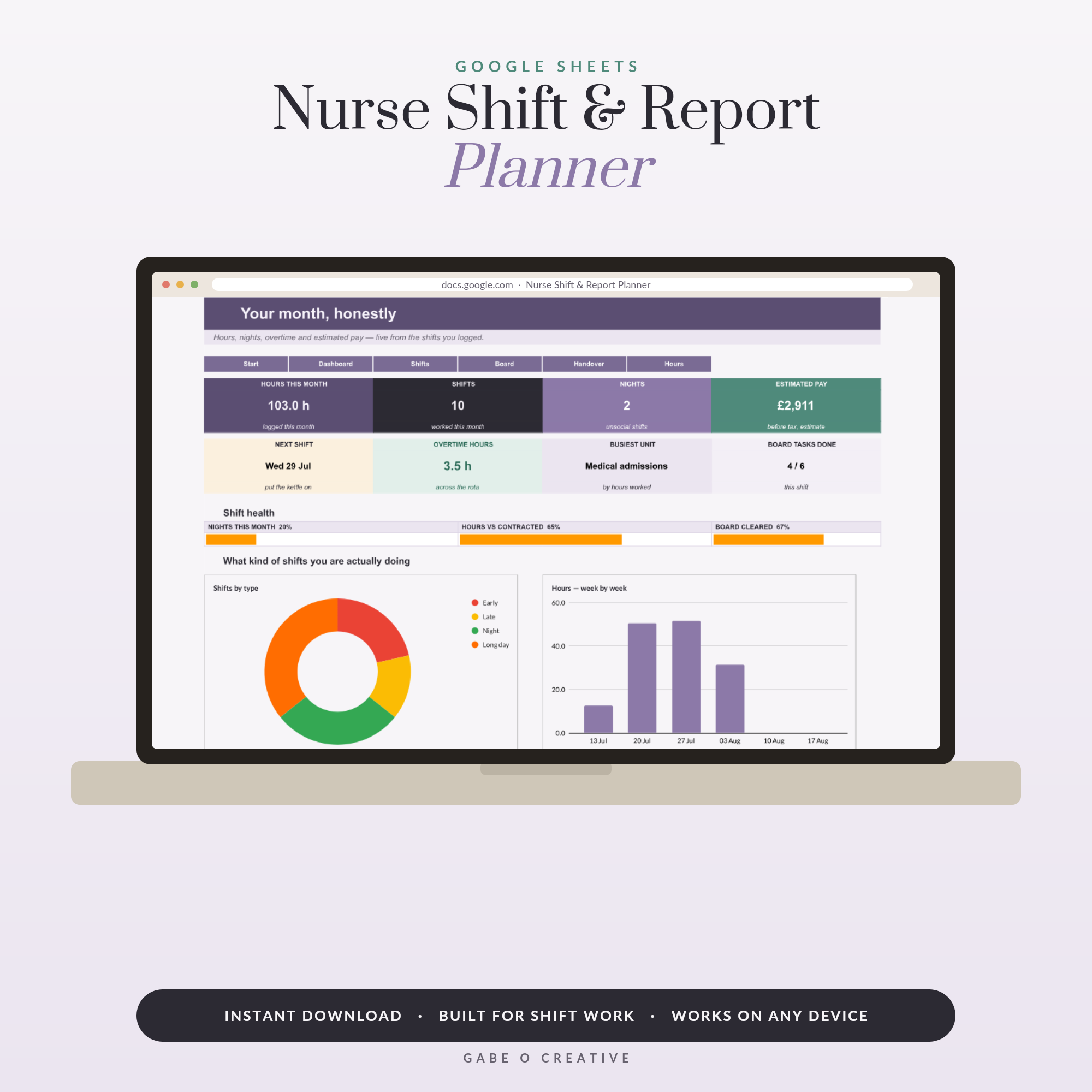
Most nurses discover a pay error one of two ways: two months late, or never. Not because payroll is careless, but because the thing being paid — a rota of nights, long days, swaps, bank shifts and the odd stayed-late — is genuinely complicated, and almost nobody keeps a record of their own to check it against. Tracking nurse shifts and pay is ten seconds per shift, and it is the difference between a suspicion and a query someone can act on. The Nurse Shift & Report Planner is built around exactly those ten seconds.
Starting a new rota this month? The Nurse Shift & Report Planner logs each shift once and works out hours, nights, overtime and estimated pay for you — with a running total against your contracted hours.
 View product →
The Six Fields That Matter
Everything useful comes from six columns, and adding a seventh is how these things die:
- Date — the shift's own date, not the date you were paid.
- Shift type — early, late, night, long day, study, annual leave, sick.
- Unit — which ward or department, because bank work often crosses several.
- Hours actually worked — not the rostered hours.
- Overtime — kept separate, because it is paid separately.
- Bank or contracted — the single most useful tag on the sheet.
Actual hours, not rostered hours
This is the field people skip and the one that matters. A long day rostered at 12.5 hours that finished at 20:40 because handover overran is not 12.5 hours. Whether you can claim that time depends on your employer's terms — but you cannot have the conversation at all if the only record is your memory of a Tuesday in March.
How the Uplifts Actually Work
Three things sit on top of basic pay, and they behave differently:
| Element | Roughly how it works | Where it goes wrong |
|---|---|---|
| Unsocial hours | A percentage uplift for nights, weekends and bank holidays, varying by band | Applied to the wrong shifts, or a night split across two dates |
| Overtime | Extra hours beyond contracted, often at an enhanced rate | Recorded as ordinary hours, or missed entirely |
| Bank shifts | Paid separately, frequently a month behind | Missed cut-off, wrong cost centre, appears the following month |
The exact percentages depend on your band and your employer's terms, so check your own contract rather than any figure you read online — including this one. What is consistent is where errors cluster: at boundaries. A night shift spanning midnight, a bank shift near the payroll cut-off, a swap agreed verbally. Anything crossing a line is worth a second look.
The midnight problem
A night shift starting Sunday at 19:30 and ending Monday at 07:30 straddles two days, two weeks and sometimes two months. Systems differ on which side it lands. Log the shift against its start date consistently and note that you do — then at least your record and the payslip can be compared like for like.
 View product →
Checking a Payslip Properly
Once a month, ten minutes. Take your total hours for the pay period from your own record and compare against the payslip. If they match, stop — you are done.
If they do not, work through it in this order: first count the shifts, because a missing shift is the commonest cause and the easiest to prove. Then check the nights, since unsocial uplift missing is the second. Then overtime. Then bank shifts, remembering those often lag a month by design rather than by error.
When you raise it, bring dates and units rather than a total. "I'm about eighty pounds short" is hard to investigate. "I worked nights on the 14th and 15th on medical admissions and I can't see the unsocial uplift for either" is a query payroll can resolve in one look.
When the Numbers Do Not Match
There is an order to this, and starting at the wrong end wastes weeks.
First, your own record against the payslip. Establish the gap precisely before raising anything. Half of apparent errors are bank shifts landing a month later by design.
Then the rota coordinator or ward manager. Most genuine errors originate at the rostering stage — a shift entered against the wrong week, a swap recorded one way round. That is fixed locally, often in minutes, and never by payroll.
Then payroll, with dates, units and shift types written down. Send it in writing rather than catching someone in a corridor, so there is a record and a reference number.
Then your union representative, if it is not resolved or if it turns out to be systematic rather than a one-off. Repeated missing unsocial uplift across a ward is not your admin problem to solve alone.
Keep it factual and specific at every stage. Payroll teams fix things they can look up; they cannot do much with a general sense that something is off.
What Else the Record Gives You
Pay is the obvious use and probably not the most valuable one.
A month of logged shifts shows you your actual pattern — how many nights in a row, how many days off between sets, how often you were on a unit you do not normally work. That is the evidence you need for a flexible working request, a banding conversation, or simply for noticing that you have done five nights in nine days before your body notices for you.
It also answers the question every nurse gets asked at appraisal and nobody can answer precisely: how much bank work did you actually do this year?
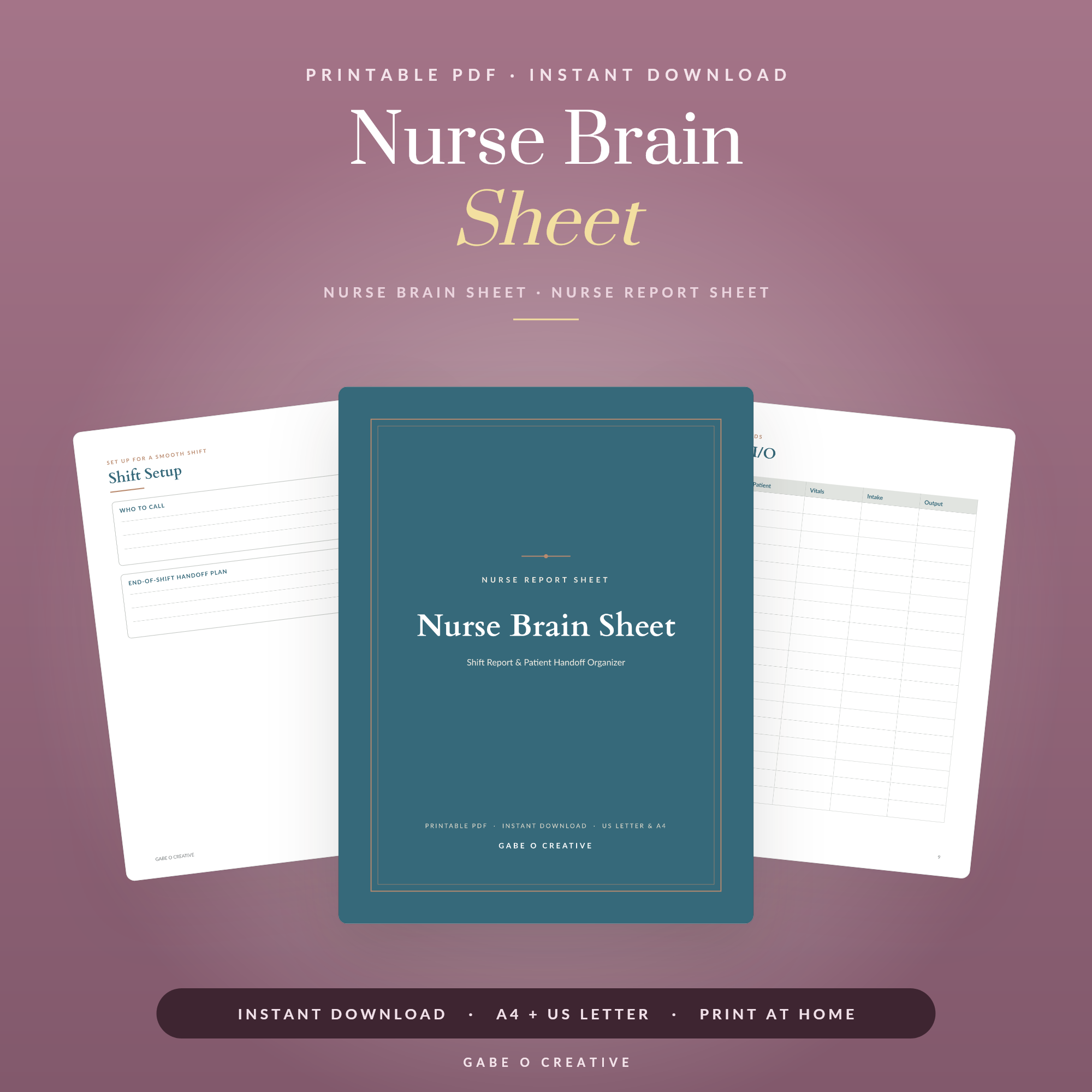
The shift itself needs a different tool from the rota. Our guide to the med surg brain sheet covers what to write down during the shift, and the nurse brain sheet printable covers the format more generally. For an editable version you can match to your own ward, the Nurse Brain Sheet Studio has med-surg, ICU, A&E and paediatric layouts, and the printable nurse report brain sheet is the fixed-layout alternative.
Shift and Pay Tracking FAQs
What should I record for each shift?
Date, shift type, unit, hours actually worked, any overtime, and whether it was a bank or contracted shift. Six fields, ten seconds. The two people usually skip — actual hours and unit — are the two that matter most when a payslip looks wrong.
How do unsocial hours payments work?
Broadly, work at nights, weekends and bank holidays attracts a percentage uplift on top of basic pay, with the rate depending on your band and your employer's terms. The principle is standard; the exact percentages are not, so check your own contract rather than a general figure.
Why is my pay different from what I expected?
Usually one of four things: a shift logged against the wrong week, a bank shift that missed the cut-off, unsocial hours not applied, or a swap recorded for the wrong person. All four are visible if you have your own record and invisible if you do not.
How far back can I query a payslip?
Most NHS and private employers will investigate underpayments going back several months, and some considerably further. But every payroll department will ask what you worked and when — so the practical limit is usually how far back your own records go.
Should I track bank and agency shifts separately?
Yes. They are paid on different terms, often by a different route, and they are where errors concentrate because they sit outside the standard rota. Tag them clearly so you can total them on their own.
Is it worth tracking if my pay is usually right?
The tracking earns its keep in two other ways: seeing how many nights you have actually done in a run, and having evidence when you ask about flexible working or a banding review. The payslip check is a bonus.
This is a personal record-keeping guide, not employment, payroll or financial advice. Pay terms vary by employer and band — always check your own contract and speak to payroll or your union representative about a specific query.
Start with this set of shifts. Open the Nurse Shift & Report Planner, log them as you work them, and check the first payslip that follows — or browse the full Google Sheets collection.