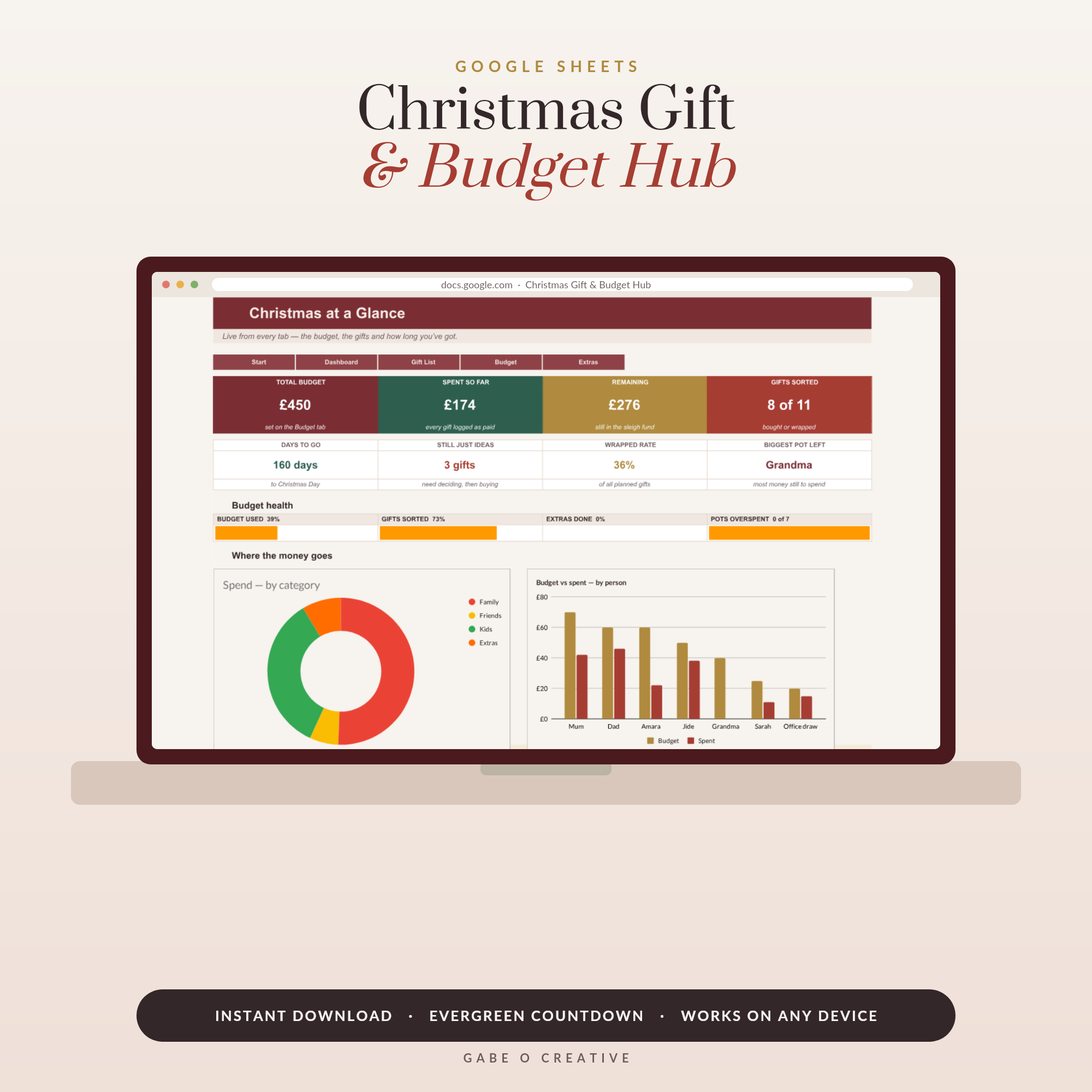
Almost nobody decides to overspend at Christmas. What happens instead is that the spending is never decided at all — a list gets written, things get bought as they are found, and the total is discovered in January when the statement arrives. A Christmas gift budget is simply the decision made in advance instead of in retrospect, and the reason to make it in August rather than November is that in August you still have months to spread it over. The Christmas Gift & Budget Hub is built around that arithmetic.
A gift budget only means something next to the rest of December's spending. The free Google Sheets budget template puts the whole month on one page, so Christmas is a line in the budget rather than a separate pot of hope.
Thinking about it early this year? The Christmas Gift & Budget Hub holds your list, your per-person amounts and what you have actually spent in one Google Sheet, and totals it as you go — so the number is never a surprise.
 View product →
Start With the Total, Not the List
The order matters more than anything else here. Most people write the list first, put a figure next to each name, add it up, and treat whatever appears at the bottom as the budget. That is not a budget — it is a total, and it will be whatever the list happens to produce.
Do it the other way round. Decide what you can genuinely put aside each month between now and December without shortchanging anything else, multiply by the number of months left, and that is the money that exists. Everything after that is allocation.
The figure this produces is often smaller than the one the list would have generated, and that gap is precisely the point. It is the difference between a Christmas you have paid for and a Christmas you are still paying for at Easter.
Count the months honestly
If you are reading this in August, you have four or five instalments before the shopping starts in earnest. That is the entire advantage of planning early — not that you buy sooner, but that the same total arrives in five pieces rather than one. Leave it until November and there is only one payment, landing in the month that already has the highest spending of the year.
Nothing about this is urgent in August, which is precisely why it works now and not later. There is no shopping pressure, no sales to react to, and no sense that a decision has to be made today — you are making arithmetic decisions in a calm month about a month that will not be calm. The alternative is making the same decisions in December, quickly, in shops, while tired, and the whole industry is designed around you doing exactly that. Four months of small transfers is a boring plan, and boring is the entire advantage.
The List That Actually Controls Spending
Once the total is fixed, the list becomes a way of spending it rather than a way of generating it. Four columns is enough: who, planned amount, what you decided on, and what you actually paid.
The last two are the ones that do the work. "What you decided on" turns browsing into buying — an open-ended search for something nice for your sister costs far more than going out to buy a specific thing. And "what you actually paid" is what makes the budget real, because until the actual sits next to the planned, overspending stays invisible.
Divide the total, then adjust
Split the budget across the list roughly, then move money between people deliberately. Some names genuinely warrant more, and a budget that pretends otherwise gets abandoned the first time it collides with reality. The rule is not that every allocation is equal, only that the increases are funded by decreases somewhere else rather than by expanding the total.
What People Forget to Budget For
This is where most Christmas budgets quietly fail. The gift list gets planned carefully, and then a second Christmas happens alongside it that nobody costed.
| Category | Commonly forgotten |
|---|---|
| Food and drink | The big meal, but also the fortnight of extra hosting around it |
| Travel | Fuel, trains booked late, parking, an overnight stay |
| Postage and packaging | Posting gifts, wrapping paper, tape, cards, stamps |
| Obligation gifts | Teachers, neighbours, colleagues, secret santa, the host |
| Decorations | Replacing what broke, the tree, batteries for everything |
| December socialising | Meals out, work drinks, childcare while you go |
For a lot of households that column adds up to something close to the gift budget itself. It does not need to be eliminated — it needs to be written down, because an expense you have planned for is an expense and an expense you have not is a shock.
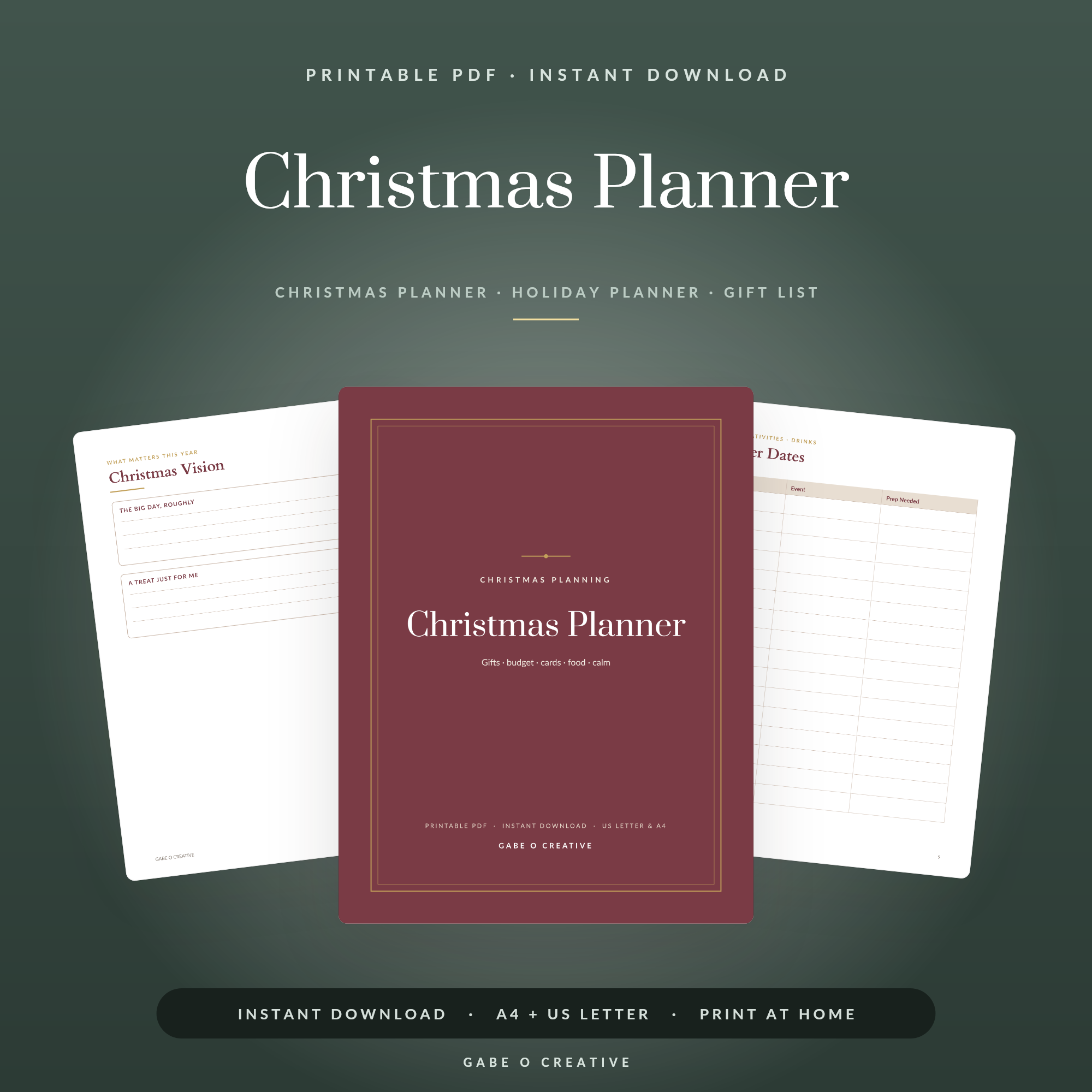
If you would rather keep the whole of December on paper rather than in a spreadsheet, the Christmas Planner covers the same ground in printable form, including the food and hosting side.
Saving It Before December Arrives
A budget is only a plan until the money is somewhere. The mechanism matters less than the separation — a named savings pot, a second account, an envelope, anything that is not the account you spend from day to day.
Set the monthly amount by dividing your total by the months remaining, and move it on payday rather than at the end of the month. Money left until the end of the month is money that has already had a chance to be spent on something else.
Treating it as a sinking fund rather than a savings goal helps psychologically: this is not money you are trying to accumulate, it is money you are pre-paying against a bill you already know is coming. Our guide to sinking funds covers the same idea applied to the rest of the year's irregular costs, and the Savings Challenge Tracker is useful if you respond better to a visible chart filling up than to a standing order you forget about.
 View product →
Tracking As You Buy
The budget survives or dies in the three weeks when you are actually shopping, and the discipline needed is small: record the real amount on the day you spend it.
Not at the weekend, not from receipts in January. On the day, in the same place as the plan, so the running total updates while you can still do something about it. A spreadsheet earns its place here over a note on your phone for exactly one reason — it adds up on its own, and a list that adds up tells you something a list that does not cannot.
Expect to go over on some names. That is normal and it is fine, provided you know it has happened, because then it can be taken off somewhere else. What is not fine is finding out in aggregate, months later, when every individual decision has already been made and there is nothing left to adjust.
Check in twice, not constantly
Once in late November and once in mid-December is enough. Look at the running total against the budget, and if you are over, decide what comes off the list rather than deciding to worry about it. A budget's only real function is to make you choose earlier than you otherwise would.
Christmas Gift Budget FAQs
How much should I spend on Christmas presents?
There is no correct figure, only a figure you can pay for without borrowing. Work backwards: decide what you can put aside each month between now and December, multiply it out, and that total is your budget. A number arrived at that way is defensible in a way that a per-person guideline never is.
When should I start a Christmas budget?
As early as you are willing to think about it. Starting in August means five instalments before December; starting in November means one, and that one lands in the same month as everything else. The earlier you start, the smaller each payment and the less tempting credit becomes.
What do people forget to budget for at Christmas?
Food and drink, travel, postage, wrapping, cards, decorations, secret santas, teacher and neighbour gifts, and the extra socialising through December. For many households the non-gift spending is close to the gift spending, and it is almost never written down.
Should I set a per-person limit?
Set the total first, then divide. Doing it the other way round means the total is whatever the list happens to add up to, which is how budgets get discovered rather than decided. Per-person limits are useful, but only inside a total you have already committed to.
How do I stop overspending once I start shopping?
Record what you actually spent next to what you planned, on the day you buy. The gap between planned and actual is invisible until it is written down, and by the time a bank statement shows it in January the decisions are all made.
Is it worth using a spreadsheet rather than a list on my phone?
A list tells you what to buy. A spreadsheet tells you whether you can afford it, because it totals as you go and compares against what you set aside. If you only ever want a reminder, a note is fine — if you want the budget to hold, it has to add up.
This is general budgeting guidance for personal planning, not financial advice. If debt is already a concern, speak to a free debt advice service rather than a spreadsheet.
Set the number while it is still quiet. Open the Christmas Gift & Budget Hub, put in your total and your list, and let it total as you shop — or browse the full Google Sheets collection.