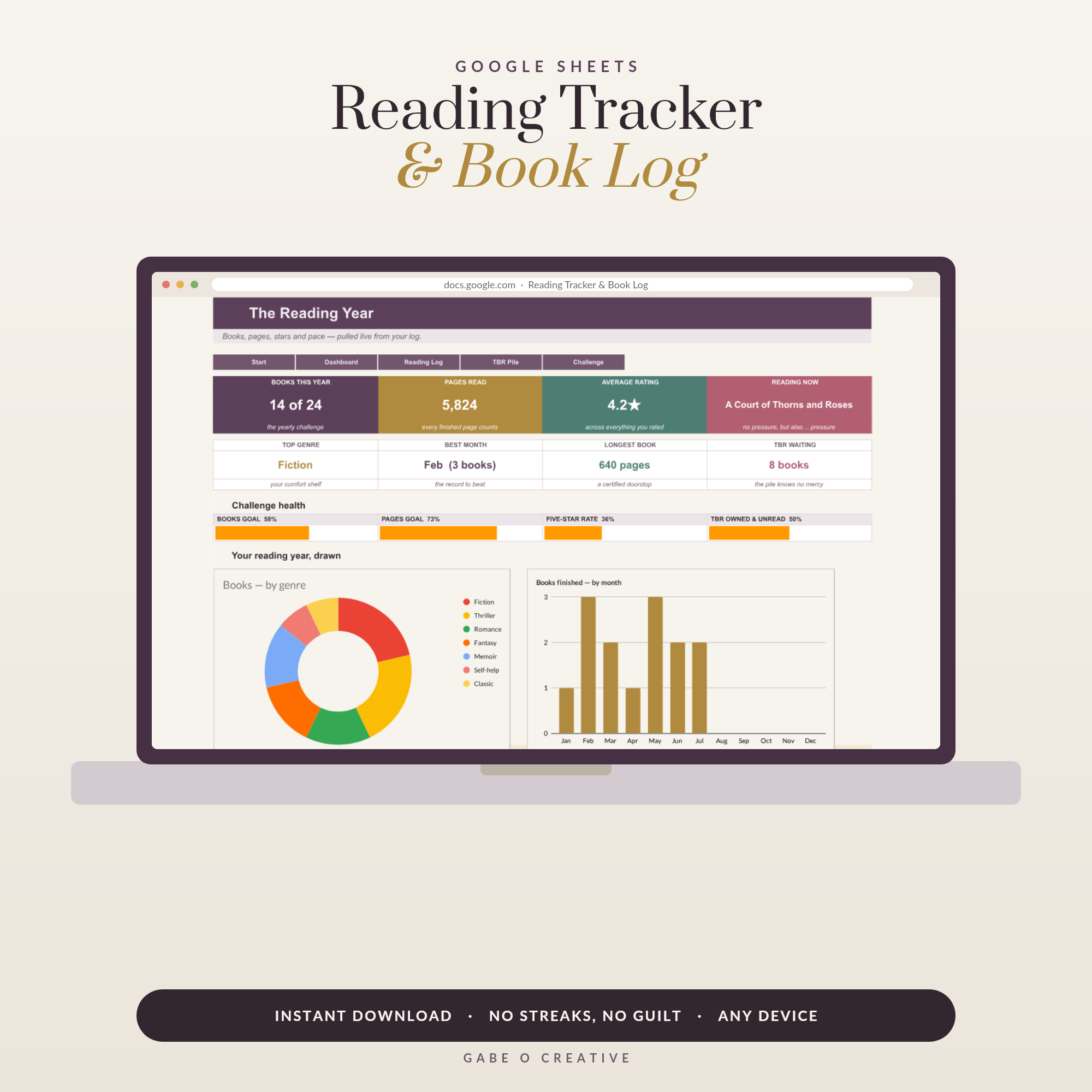
There is a specific way that tracking ruins reading. You start logging books, the number becomes visible, and within a couple of months you are choosing shorter books, finishing things you dislike because abandoning them costs you a row, and feeling faintly behind in a hobby that is supposed to be the opposite of that. A reading tracker spreadsheet is worth keeping, but only if it is built to record rather than to score. The Reading Tracker & Book Log is deliberately built the quiet way.
Want the record without the pressure? The Reading Tracker & Book Log logs what you read in four fields, keeps a to-be-read list beside it, and does the year's summary itself — in Google Sheets, no targets required.
 View product →
Four Fields Is the Whole System
Title, author, date finished, and one line about it. That is a thirty-second entry, and thirty seconds is the correct cost — anything longer and the logging competes with the reading.
The one-line note is the field that matters and the one people leave out. Not a review; a sentence. "Slow start, worth it." "Read it in two sittings on holiday." "Everyone loves this and I could not tell you why." In a year those sentences are the entire value of the sheet, and no rating system reproduces them.
Log the date you finished, not the date you started
Start dates are unreliable — books get abandoned for a month and picked up again, and half of them will be wrong. Finish dates are unambiguous and they are what makes the year readable afterwards.
Why Ratings Mislead
A star rating compresses a book into a number you will not be able to decode later. Three stars can mean genuinely fine, or disappointing given the hype, or good book read at the wrong time. A year on, the number tells you nothing and the sentence tells you everything.
If you want a scale, use one with two options: would recommend and would not. It is honest, takes no thought, and is far more useful when someone asks what to read next — which is, realistically, the main practical use anyone gets out of a reading log.
| Field | Keep? | Why |
|---|---|---|
| Title and author | Yes | Obviously — and the author column is what reveals patterns |
| Date finished | Yes | Unambiguous, and makes the year readable |
| One-line note | Yes | The only field still valuable in five years |
| Format | Maybe | Useful if you mix audio and print, pointless otherwise |
| Page count | No | Turns long books into better value than short ones |
| Star rating | No | Compresses away the thing you actually wanted to remember |
| Genre | No | Sounds useful, never gets filled in consistently |
Track the Ones You Abandoned
This is the counterintuitive part and the most useful. Give abandoned books a row, with the point you stopped and one line on why.
Finished books tell you what you got through. Abandoned books tell you about your actual taste, which is different and more honest. A year of them usually reveals something specific — that you do not get on with a particular kind of narrator, or that you keep buying books you feel you ought to read rather than ones you want to.
There is also a permission effect. When abandoning a book is a logged outcome rather than a failure, people put down more books they are not enjoying, and read more as a result. The tracker stops being a thing that pushes you through bad books to protect a number.
Keep the to-be-read list on the same sheet
A second tab, not a second system. The value is being able to see what you have just read next to what you were going to read — that is the moment you notice you have bought four books in a row you are not actually excited about.
Add one column to it: where the book came from. A friend, a review, a shop, an algorithm. After a year that column quietly answers a question worth knowing — which sources actually give you books you finish, and which ones you keep buying from out of habit. For most people the answer is not the one they expected, and it changes what they buy far more than any resolution about reading more.
 View product →
What a Year of Data Is Actually For
Not the total. The total is the least interesting number in the sheet, and it is the one every reading app puts at the top.
What is genuinely useful: which months you read almost nothing, and what else was happening then. Whether the books you loved came from recommendations, browsing, or a particular publisher. How many you abandoned and whether that number should honestly be higher. Whether last January's resolution about reading more of something ever survived past March.
Those are questions memory answers badly and a plain list answers immediately. None of them requires a target, a streak or a badge.
Do the review in one sitting, once
Late December or early January, read the year's list top to bottom. It takes ten minutes and it is the entire payoff — the point at which a list of rows becomes a picture of a year. Everything else in the sheet exists to make that ten minutes possible.
Paper, App or Spreadsheet
All three work; they fail differently. Apps are the easiest to start and the hardest to leave, because they are built around social scores and their own recommendations, and your data is only as portable as they allow. Paper is the most pleasant and the least searchable. A spreadsheet is the dullest and the one still readable in a decade.
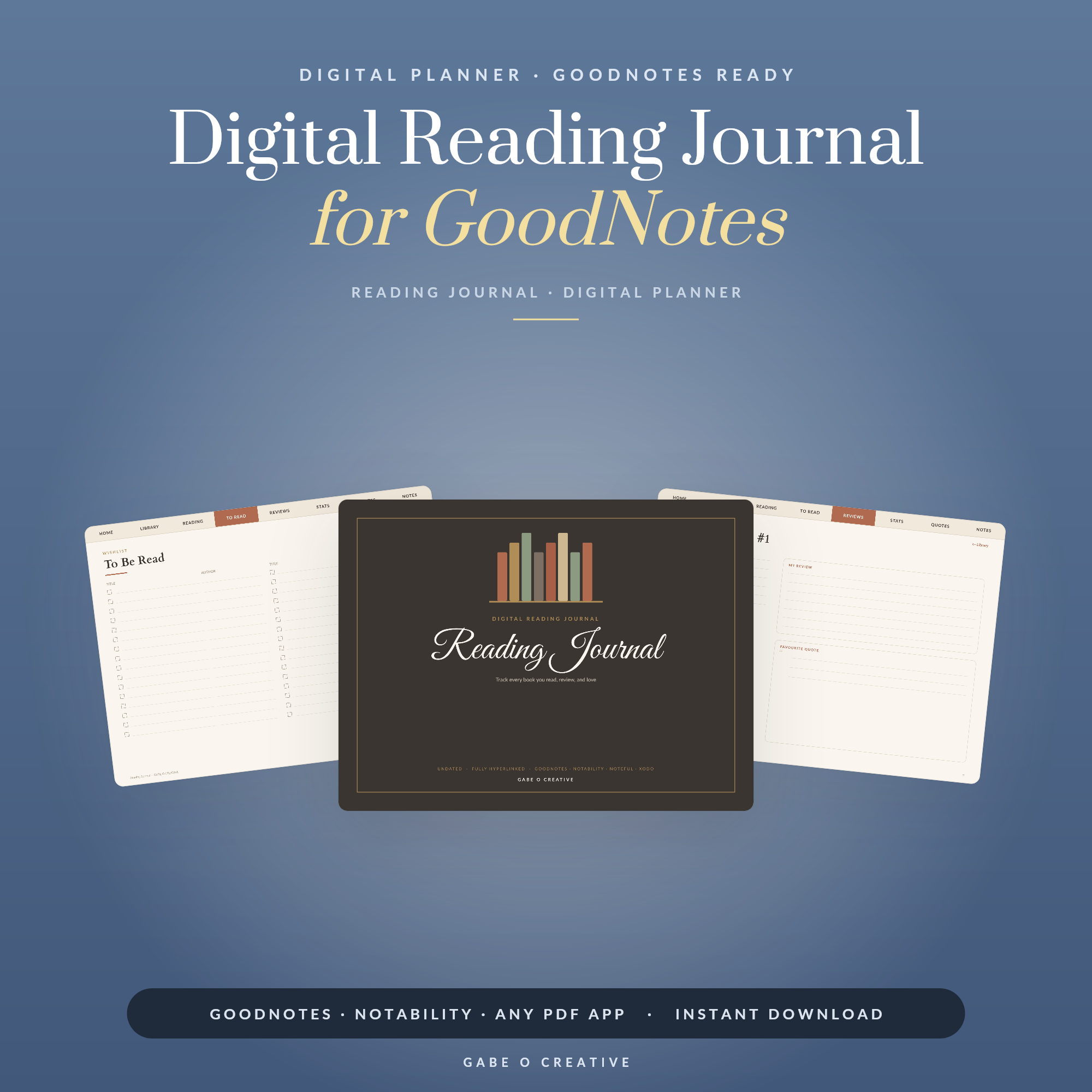
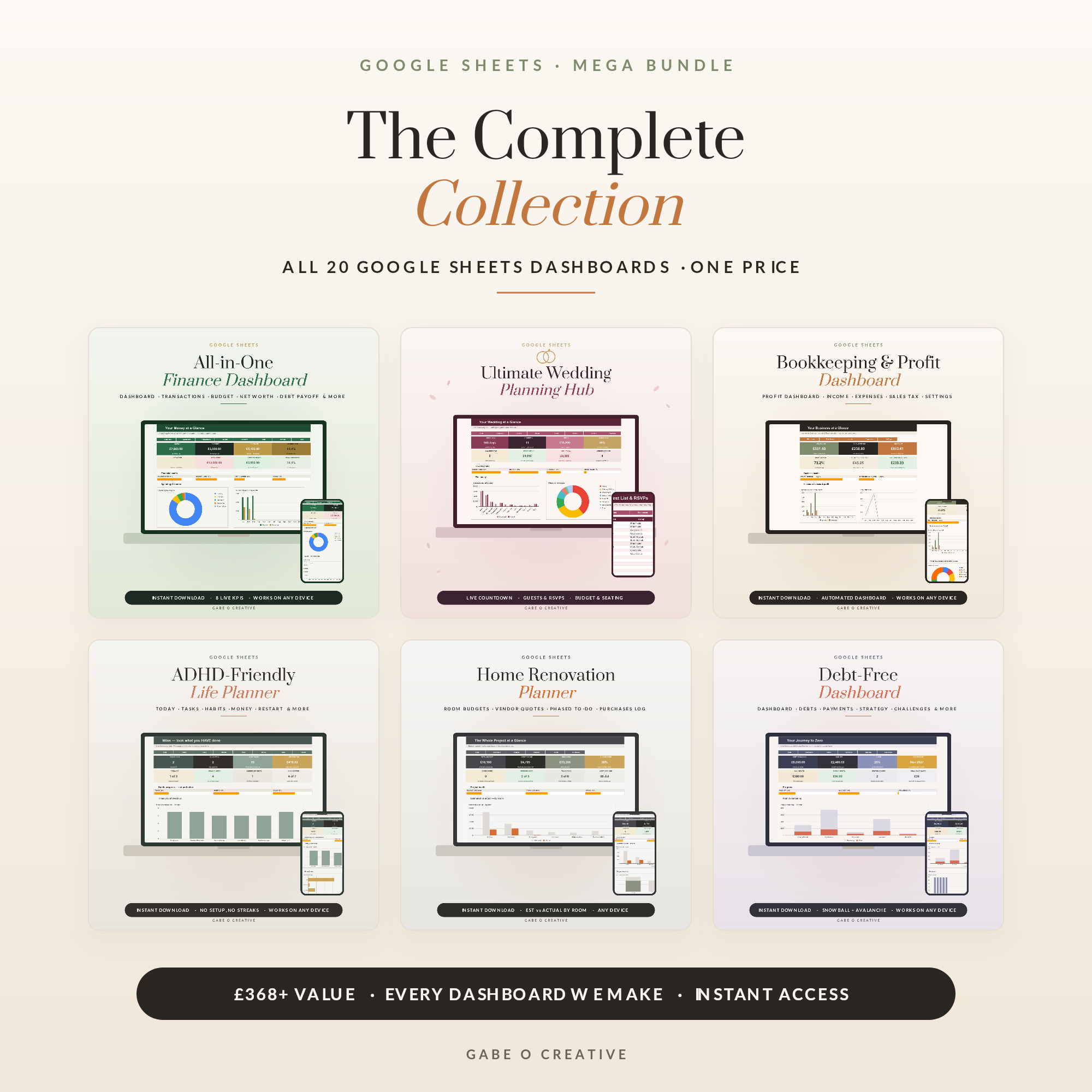
If you would rather write than type, the Digital Reading Journal is the GoodNotes version of the same four fields, and our guide to the reading challenge printable covers the prompt-led approach if a bit of structure genuinely helps you read more. For the spreadsheet route across everything else in life, the complete Google Sheets bundle includes this alongside the planners and finance dashboards.
Reading Tracker FAQs
What should I log for each book?
Title, author, the date you finished it, and one line about it. Four fields, thirty seconds. Everything else — page counts, genres, formats — is optional, and every optional field you add makes it slightly more likely you stop logging at all.
Should I track pages or books?
Books, unless you have a specific reason not to. Page counts make long books feel like better value than short ones, which is not how reading works, and they quietly push you towards finishing things you are not enjoying just to bank the number.
Are star ratings useful?
Less than they look. Ratings compress a book into a number you will not understand in a year — a three could mean disappointing or perfectly fine. One honest sentence about what it was actually like is far more useful when you come back to it.
What about books I did not finish?
Log them, with a note on why you stopped. Abandoned books are the most useful data in the whole sheet, because the pattern in what you put down tells you more about your taste than the ones you dutifully finished.
Should I set a yearly reading goal?
Only if a target genuinely motivates you rather than shames you. For plenty of people a number turns reading into a KPI and pushes them towards short books in December. Tracking without a target still gives you everything useful about the record.
Why use a spreadsheet rather than an app?
Because you own it and can shape it. Reading apps are social by design and nudge you towards their scores, their challenges and their recommendations. A sheet just records what you read — and it is still readable in ten years, which no app can promise.
Start with the book you are on now. Open the Reading Tracker & Book Log, log it in four fields, and let the year build itself — or browse the full Google Sheets collection.