A women-of-the-Bible study is easy to describe and easy to do badly: read the passage, feel briefly moved, move on. The method that actually changes how you read Scripture has three steps done in order every time — her story, her lesson, your life — and it's much clearer worked through once in full than described in the abstract. Ruth is the clearest place to see it, because her whole story fits in four short chapters and turns on one decision.
Step one: her story, read in full
The temptation is to jump straight to the famous line. Read the whole passage first. Ruth's story opens with loss, not loyalty: her husband, her brother-in-law and her father-in-law have all died, leaving her, her mother-in-law Naomi and her sister-in-law Orpah as widows with no income and no protection in the world they lived in. Naomi tells both younger women to go back to their own families and start over — the sensible advice, and Orpah takes it. Ruth doesn't. Her answer to Naomi is one of the most quoted lines in the Old Testament: "Where you go I will go, and where you stay I will stay. Your people will be my people and your God my God" (Ruth 1:16). Read on its own, it's a devotional line. Read after the context, it's a decision made with everything to lose and nothing obvious to gain.
Step two: her lesson, stated plainly
This is the step people skip, or do too vaguely to be useful. "Ruth was loyal" isn't a lesson, it's an observation. A real lesson names what the story actually shows about how faith works under pressure: Ruth's commitment came BEFORE any of the good that followed it — the security, the remarriage to Boaz, the place in the family line that leads to King David. She didn't know any of that when she made the choice in chapter one. The lesson worth sitting with is that her loyalty wasn't a strategy that paid off; it was a decision made in genuine loss, before there was any sign it would work out. That's a very different, much more useful lesson than "be loyal like Ruth."
Step three: your life, made specific
The last step fails when it stays general ("I should be more faithful") instead of naming something real. A specific version looks like: where in your own life right now does staying feel like the harder, less obviously rewarding choice than leaving — a relationship, a commitment, a hard season you're tempted to walk away from before it's resolved? Write the actual situation down, not a vague intention. That's the difference between a study that changes how you think for five minutes and one you can return to.
The same three steps, applied to a second example
Esther's story shows the same method with a different kind of pressure. Her cousin Mordecai's words to her — "who knows whether you have not attained royalty for such a time as this?" (Esther 4:14) — are often quoted alone as a statement about purpose. Read in context, they were spoken while Esther was weighing whether to risk her life by appearing before the king uninvited, to try to stop a planned massacre of her own people. Her story: a position of real risk, not just opportunity. Her lesson: the position she was already in — one she hadn't chosen for this purpose — turned out to be exactly what the moment needed. Your life: where do you already have a position, a relationship or a piece of influence that you've never thought of as being "for" anything in particular, until a specific moment asks something of it?
Building a habit of studying more than one
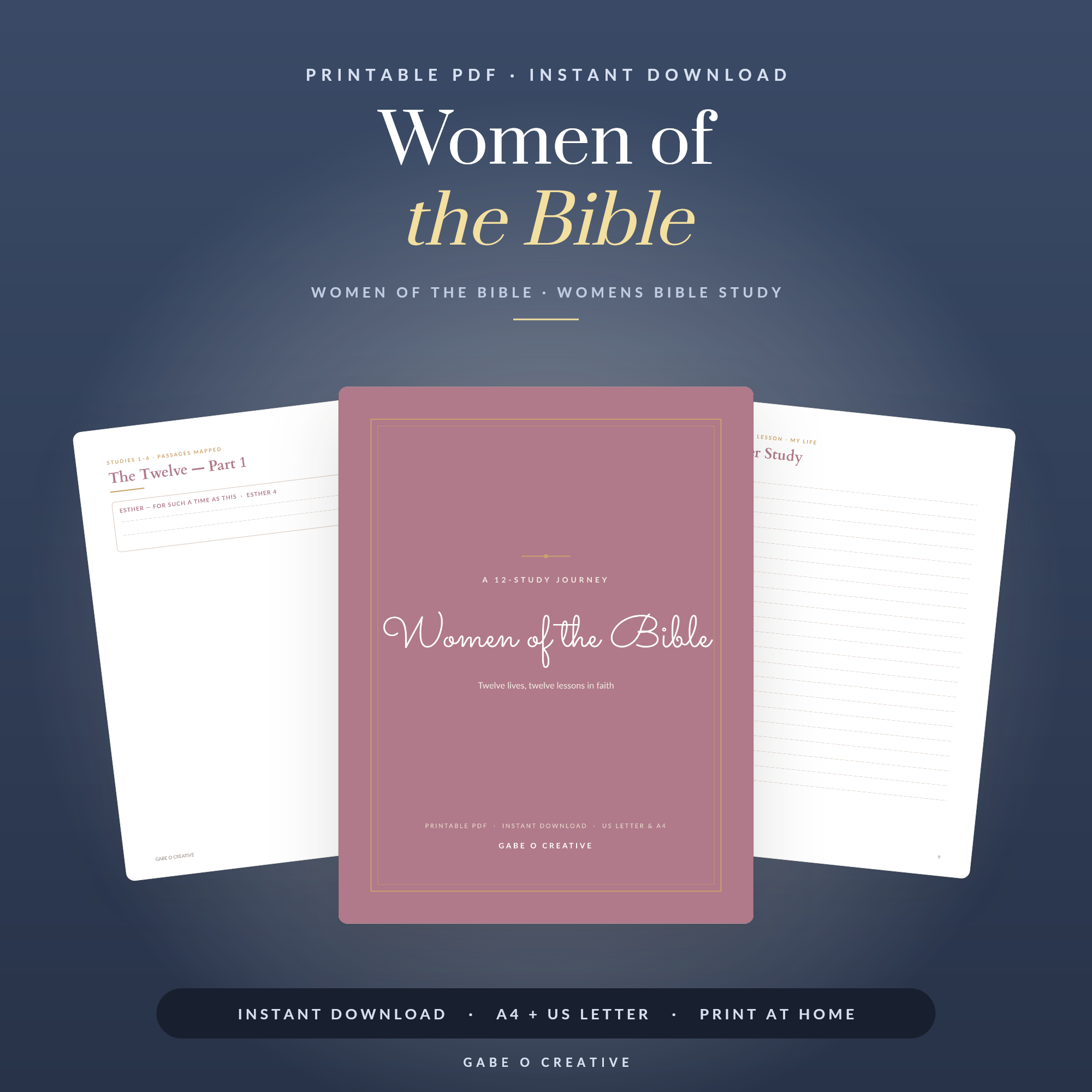
Working through twelve women this way — Ruth and Esther, but also Hannah's prayers, Mary's response to an impossible request, and the others across both testaments — gives you the same three-step method applied to loyalty, grief, courage, faith and doubt in turn, rather than one lesson repeated twelve times. The Women of the Bible study journal maps the passages for all twelve and gives each one its own her-story/her-lesson/my-life pages, so the structure above is already built in rather than something to recreate from scratch each time.
If you'd rather study a theme than a person, a study of the names of God works through Scripture the same structured way from a different angle, and a prayer and fasting journal pairs well alongside either one for the weeks you want to go deeper than a single sitting. For daily use in between studies, a prayer and Bible study journal keeps the same habit going on the days you're not working through a specific character.
Whichever translation you read from — the specific wording above is from the NIV, but the same passages read just as clearly in the ESV, NLT or KJV — the three steps stay the same: read the whole story, name the lesson specifically, and make your own life specific too. That's the actual method, not just something to feel while reading.